Separating the art from the artist, and the moral responsibility of artist and audience
on why talent can't excuse bad character
reading now kept times
Separating the art from the artist, from Lynch and Kusama to Jackson and Polanski: talent excuses no harm, and the audience has a share in what it forgets.
thoughtNov 18, 202641 min readartphilosophysociety
“Hypocrisy is the result of an unveiling that stops before it reaches the self.”
When David Lynch died at the start of 2025, I spent the weeks after it the way a lot of people did, going back through the films and the interviews and the odd little weather reports he used to post from his window in Los Angeles, and what stayed with me was how little there was to forgive, a man who made some of the darkest work of his time and seemed to have kept so little of that darkness in the way he lived, which I tried to put into words in the log I wrote the day he died. A little more than a year later a sentence started following me around, under videos and in captions and eventually as the title of an essay, that it's okay to be evil if you're talented, usually said as a joke that also sounded like relief, as if someone had finally admitted out loud what everyone had been doing all along, and I could not stop setting it beside the memory of Lynch, because if a gift that large could live alongside a life that ordinary in its decency, then I wanted to know why so many of us had come to assume that a gifted artist would need an excuse at all.
Then this August Yayoi Kusama died in a hospital in Tokyo at ninety-seven, and her studio said she had kept painting until her final days without ever setting down her brush, and I found myself holding the two of them side by side, a filmmaker who went looking for the darkness under American suburbs and a painter who had lived since childhood with visions that threatened to swallow her, both of them closer to the abyss in their work than most of us will ever go, and neither of them leaving behind the kind of wreckage that talent is so often used to excuse. Their lives make it hard for me to believe that being an artist, even a great one, comes with a license to harm the people around you, and I want to understand what they did with their darkness that so many others refused to do.
There is an immediate and instinctive idea that artists hold a strict and principled view of morality and ethics. The artist, after all, is a vessel through which the ideas of liberation are channeled. The artist carries a vision that shows a path forward, oftentimes shining light and focusing on the issues of the current milieu in an aesthetic manner to shake the complacent consciousness of the masses. There is that promise that the artist can point us toward a kind of transcendence, an experience that lifts us out of what keeps us small while letting us carry with us whatever still makes us human.
Is that a misguided expectation? Have I been glorifying the idea of The Artist up until today? What becomes of that promise when the artist who gives us one of the defining works of his age fails his own moral responsibility to the people around him, letting himself be consumed by his demons while the work goes on carrying an aesthetic greatness that ought to have been the reflection of a moral standard he never kept?
And is it even a fair expectation for us, as an audience, to ask artists to be good moral agents, and what does it say about us, whether we hold them to it or let it go because the work is great enough to make us want to?
The artist as a human
We can say that the artist has his own unprocessed traumas and unresolved conflicts within himself. Those wounds may help explain how deeply an artist feels the world, though they explain nothing about what he chooses to do to the people around him, and in that sense the artist is an ordinary human carrying an unusual sensitivity, someone who stands slightly to one side of everyone else. Artists have long been cast as the outsiders of the collective consciousness, and standing at its edge is what lets them see what the people at its center have stopped noticing. Very little passes through the artist lightly, since whatever he meets in the world tends to stay with him and keep working on him long after other people have let it go. Van Gogh, through the depressions that eventually brought him to the asylum at Saint-Rémy, kept looking at the same fields and the same night skies until they came back to him charged with a light no one else had seen in them. It was the view from his bedroom window there, painted from memory in a studio room on the floor below, that gave him The Starry Night. Dostoevsky stood before a firing squad in 1849 and was reprieved at the last moment, and he gave that minute to Prince Myshkin in The Idiot two decades later. Proust spent the last years of his life rebuilding a childhood in Combray out of the taste of a cake dipped in tea. Joyce left Dublin as a young man and never again made his home there, yet he spent his whole career walking its streets on the page from the other side of Europe. That lingering attention lets artists feel the sickness of an age before the rest of us have a name for it.
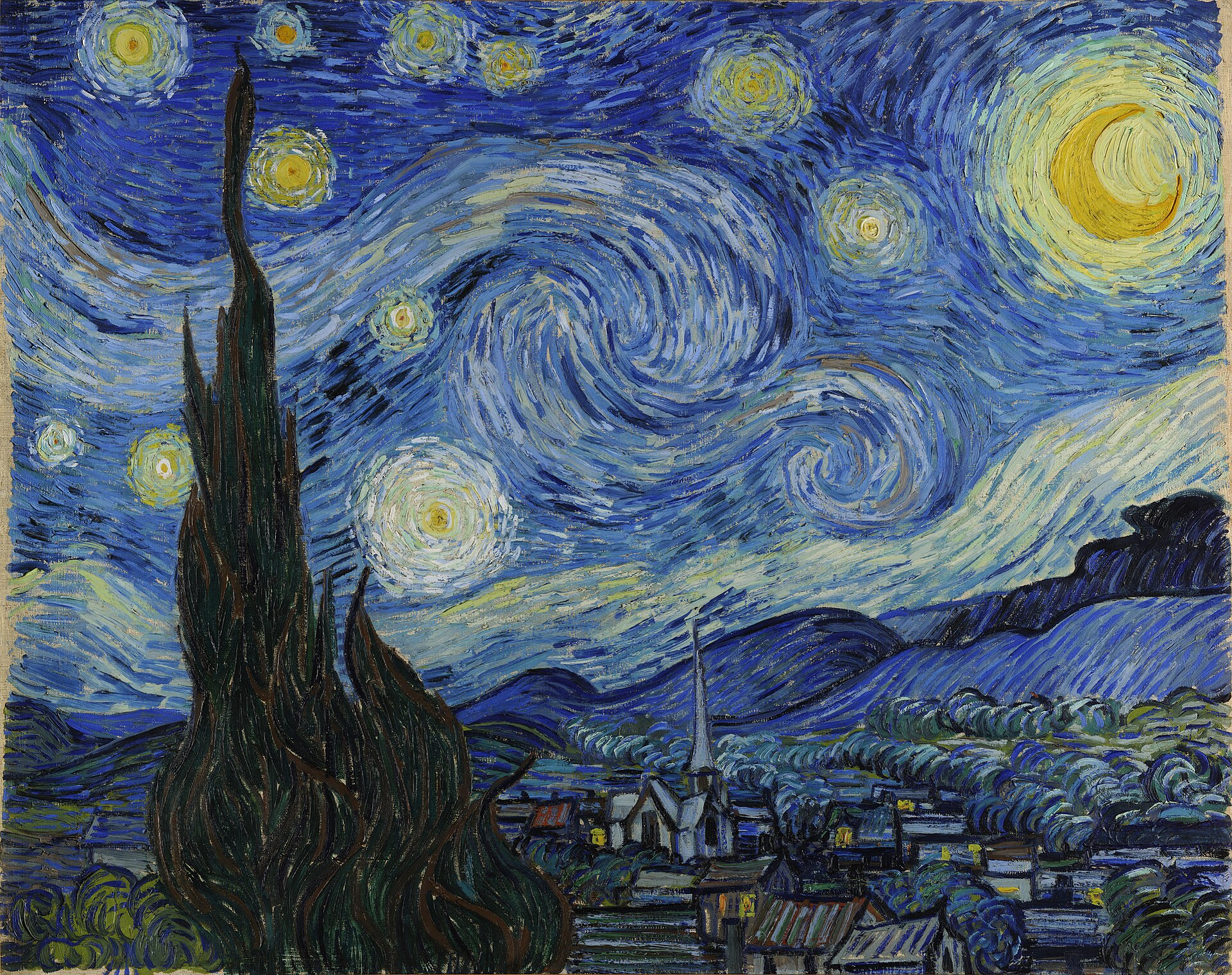
Vincent van Gogh, The Starry Night (1889), Wikimedia Commons, public domain.
In this sense, it is possible to develop a deeper perspective on human nature regardless of how they act on their own impulses. It may even be possible to preach the goodness of the world while your mind is secretly given over to the very appetites you condemn. Jean-Jacques Rousseau wrote Emile, a whole book on how a child should be raised with patience and care. Years before it appeared he had left all five of his own children at a Paris foundling hospital. He admitted this himself in his Confessions (Book IX, written around 1769 and published only after his death). Tolstoy spent his last decades preaching chastity, nonviolence and Christian love. In The Kreutzer Sonata he condemned even the desire between a husband and a wife. His own diaries record a lust he never managed to master. His wife Sofia wrote in her diary that she knew in her heart the story was aimed at her and had humiliated her in the eyes of the world, and she answered it with stories of her own. It is an awful state to be in. A person can easily slip into this, especially when the self confronts itself only in words and its confessions are never carried into practice. The self splits into two, most infamously Dr. Jekyll and Mr. Hyde, and they appear when one refuses to take control and subdue the half that propagates the vices, since that half grows stronger on the same indulgence that keeps the artist's illusions of grandeur alive.
Think of it this way: an ordinary person drinks from the mysterious well of knowledge without ever having gone looking for it, often so early in life that he is not even conscious of it, and he finds out that he is capable of seeing the world more deeply only when that sight begins to show in what he makes. Kant, in the Critique of Judgment, called genius a talent given by nature, one the artist can neither explain nor teach to anyone else. This is also why so many people speak of talent as both a gift and a curse, since he cannot hand the water back once he has drunk it, and a sight that deep stays with him whether he ever wanted it or not. A gift that heavy still has to be distilled into a form other people can receive, and the artist is born in the long work of distilling it.
At this point the artist's deeper understanding of the world can become a powerful tool for navigating the complexity of reality, and the same tool can be turned on his own conduct, building layer upon layer of reasoning until what began as a lie told to others settles into something he believes about himself. Rousseau is the clearest case I know, since over the years he offered nineteen different justifications for leaving his children, by one scholar's count, moving from his poverty to his partner's honour to the claim that the foundling hospital would raise them better than he could, as each excuse wore thin.
The artist as an artist
Artists are explorers first before they arrive to the intellectualization of the creative process. The artist is a child, who touches everything and breaks some of them. Whatever the artist sees, he points at them. Wherever he points, he goes and all the sameness and differences of the places wherever he goes, he carries within him, which is the source of his art: experience of the world.
The artwork then is an amalgamation of the artist's experience, densely concentrated at a single point, and because so much has been pressed into so small a space the work never sits quite like the ordinary objects around it. It is made strange to us, defamiliarized in the sense Viktor Shklovsky meant in his 1917 essay "Art as Technique," where he wrote that art exists to make the stone stony again,[1] and that strangeness, its artificiality and unnaturalness, is what first catches our attention. Once it has our attention the strangeness can go further, since a thing we can no longer look at out of habit can show us what habit had hidden, and in this way the work "unveils" reality, bringing forward what the collective consciousness denies or ignores as the truth of its age. There lies the power of the artist to uncover the truth of the world. A work that carries this kind of truth often finds an audience, and when it does the artist becomes something like a shaman who ferries his community to worlds he can imagine, even if the people following him are only looking for comfort, or for an escape into the reality that people know is there and have quietly agreed not to name. With this, the artist acquires the power to move and influence people through his art.
The artist is able to shift perspectives. They have the capacity to draw connection between two or more unrelated ideas. They operate within the realm of symbols, where several ideas can be enmeshed into a single object of attention, which is the work of art.
There is a romantic idea of the "tortured artist" that always gets easily thrown around, the artist who turns the ugliness of his suffering into an aesthetic display of exhibitionism, the broken man who sings to the loss of a loved one, the madman whose trauma-induced visions are put into paint or poetry. Some of these artists really did suffer, and I do not want to make light of that, so it helps to separate the kinds of suffering the romance runs together. Some of it comes from outside and crushes, what Simone Weil called affliction, the malheur that falls on a person without asking[2]. Some of it is chosen, the discipline an artist submits to in order to master a craft, which Nietzsche praised in Beyond Good and Evil when he wrote that the discipline of great suffering was behind every elevation of humanity.[3] The romance takes the prestige of both and gives it to a third kind of suffering, that is the suffering an artist keeps alive in himself, or even invents, because being the one who suffers has become his identity. To measure an artist by how much he suffers is the cheapest definition we can give him, since it hands him a role the culture has already written, and all he has to do is play it. It is also the quickest way to win sympathy, because people are moved by the sight of someone struggling to make beauty and meaning in the world despite everything. Well, all it takes to fake the suffering is hyperbolic imagination. The world becomes a big and heavy burden to bear when the default lens is a microscope pointed at oneself, and if I make myself smaller than the world, all my pain becomes bigger than the universe. What finally separates the real cases from the impostor is what the artist does with his suffering. Kusama's suffering was imposed on her as a child, and through decades of controlled, repeated work she turned it into a practice she chose. The impostor keeps his wound open instead, because his work has come to depend on it.
This is why I think the artist is best defined by the tautology in this section's title, the artist as an artist, since it forces us to confront the artist in himself through his affirmed identity and not through whatever shaped him. Weeding out these potential falsehoods helps us understand better the responsibilities of an artist, given what he knows and what he is capable of.
Here lie the issues that I have raised at the beginning of this piece. The artist is able to will an object into existence that can shape the world without his meaning it to. This is a kind of power humans are capable of that often goes unchecked.
Does creation entail a moral responsibility? With the power to create, what does it demand from the creator?
The artist as a moral agent
In various versions of creationist myths, a singular god or multiple gods are capable of influencing the universe, and so they had a hand in its creation and its destruction. A god who creates a world must carry the responsibility for what it sets loose upon it, and the artist, who wills into the world objects that go on shaping how others see, carries a smaller share of that same burden whether he asks for it or not. What he owes in return has little to do with obedience to whatever the community already calls good, since the work that matters is usually the one that shows the community what its idea of the good has been hiding, and so the debt is a kind of honesty that has to hold in his life as much as in his work, since we stop believing a truth-teller once we see him exempt himself from what he tells us. The Greeks had a word for this kind of speech, parrhesia, and in Foucault's late lectures the one who speaks this way is believed because his life and his words agree, the way Socrates is trusted in the Laches because the way he lives already says what he says[4]. Foucault adds that the parrhesiast always takes a risk when he speaks, since the truth he tells can cost him something, and for the artist the risk is that the truth he gives form to may one day turn back on him. If telling that truth is his vocation, then keeping it credible belongs to the vocation as well.
Plato would have answered all of this by denying the artist any truth to be faithful to. In the tenth book of the Republic[5] he calls the imitator a maker of images standing third from the truth, someone who waters the passions when they ought to be governed. Yet no one took the power of art more seriously than Plato or feared more what it could do to the people who received it, and on that much he and I agree, but his answer was banishment, and I would rather leave the artist to answer for what his work does, alongside the people who listen to him.
Iris Murdoch, a Platonist herself, answered him in The Fire and the Sun[6] by taking his moral seriousness about art and using it to defend art, arguing that good art is itself a discipline of truthful attention, which places the danger Plato feared in the artist who fails to keep that attention.
Hypocrisy is the result of an unveiling that stops before it reaches the self. The artist as a hypocrite sees the sickness of his age clearly enough to give it form, and then uses that same clarity to build the layers of reasoning in order to conceal his wrongs. It is easiest to see when the work preaches something the artist does not live by. Michael Jackson sang that we should heal the world while facing accusations that he harmed the children he kept close to him, and if those accusations are true, then each time he went on singing it in the years that followed, before stadiums full of people, he was asking them to heal the world while knowing what he had done to the children in his own, which takes a kind of gall. Against that gall I think of David Lynch, who when he died left behind work as strange and dark as anything made in his time and very little of the kind of scandal that follows so many others, though he was not a saint either, having said openly that as a father and husband "you gotta be selfish," which is an ordinary failing, and one he admitted in public without trying to hide it.
The same demand holds even for the artist whose work never preaches anything, the stylist or the dancer or the painter, because a work that tells no one what to do still asks something of the one who made it. In "The Sublime and the Good" Murdoch wrote that art and morals share one essence, that "the essence of both of them is love," and she defined that love as "the extremely difficult realisation that something other than oneself is real"[7]. Even art with no moral message forces the artist to pay attention to something real outside himself. A dancer cannot perform well while she is thinking about how impressive she looks, since she has to actually register the space, the music and her partner as they move around her, and a painter who only paints the way light falls on a wall has to keep looking at the real wall and not at the idea of a wall he carries in his head. That self-forgetting attention is what Murdoch meant by love. A discipline that trains a person to see something other than himself as real cannot honestly stay inside the studio. The people who share his life are as real as the music and the wall, and they need the same patient care he gives his material. An artist who gives that care to his work but refuses it to the people around him is disciplined in front of the work and undisciplined toward his moral and social obligations.
The gift can't be an alibi for an immoral character
Whatever the talented artist hopes to be forgiven for, the gift itself cannot be the reason, since what lessens our blame for anyone has always come down to whether the act came from the person himself, without force from outside, and whether he knew what he was doing, as Aristotle has it in the third book of the Nicomachean Ethics, and talent is neither an outside force nor a kind of ignorance[8], and the artist who drank deeper from the well knows more than most of us about the harm he causes, so the understanding that made his work possible leaves him fewer places to hide. Where an illness has truly taken away his control or his grasp of what he was doing, we owe him the same mercy we would owe anyone in that condition, but that mercy belongs to the illness, and talent adds nothing to it. The old romance of the mad artist, which blurs his illness into his genius, is another form of the tortured-artist myth, letting us blame the gift, or the madness that supposedly comes with it, for what the person chose to do.
Kant makes the same point from another direction. In the Groundwork he counts the cultivation of one's talents as a duty, so a gifted person who lets his talent rust is failing something he owes. Kant files it among the imperfect duties, which we may fulfill in our own way and at our own pace, while the duty not to wrong another person is a perfect duty.[9] By his own ordering the gift cannot be traded against the harm, since a perfect duty admits no exception in favor of inclination, however gifted the person. In the Metaphysics of Morals he goes further and names "know yourself" the first command of every duty a person owes to himself. This is the self-knowledge I placed at the foundation of great art, the Delphic maxim I once tried to stare at long enough to understand, and the artist who refuses to look at what he does is failing Kant's first duty along with the foundation his own work rests on.[10]
The self that will not empty
Yayoi Kusama calls her practice self-obliteration, and what she describes is the covering of her body and the room around her with dots until there is no longer any edge between herself and the infinity she is painting, which, in her own telling, she suffered as hallucination as a child and which she went on to perform on purpose for decades until her death this year, so that what once threatened to erase her became the form through which she gave herself over to the work. I have held for a while that great art is built on self-knowledge and on a mastery that requires sacrifice, and I think the sacrifice is this emptying of the self into the work, which is why the gifted artist who does wrong is such a puzzle, since if great art asks for that emptying then he must have emptied himself to make what he made. I think his emptying is bounded, kept to the hours he spends on the work while the people around him still meet an ego left whole, and when the work is finished he claims its universality as proof of his own greatness, so the work that asked him to set his ego aside ends up feeding it.
In 1944 George Orwell wrote an essay on Salvador Dalí which he titled "Benefit of Clergy" after the medieval legal privilege that let clergymen escape trial in the ordinary courts. He borrowed the phrase as a figure for how his own age treated artists, complaining that the artist now enjoyed the immunity the clergy once had, so that once a man could paint well enough he was excused from the rules that bound everyone else. Orwell's answer was that one should be able to hold in one's head at the same time the two facts that Dalí was "a good draughtsman and a disgusting human being"[11], and that refusal to let either fact cancel the other is the discipline I will come to ask of the audience.
The psychiatrist Robert Jay Lifton, studying the doctors of Auschwitz, described what he called doubling, the forming of a second self that could do what the first would never allow while the first went on believing itself decent, a husband and father and healer at home. Lifton was careful to separate doubling from the dissociation of a split personality, which leaves the man answerable for both of his selves, and I find the same structure in the gifted who do harm, where the self that empties into the work and the self that harms are allowed to live in separate rooms, much as Stevenson divided Jekyll from Hyde.[12]
Jung would say that the self which refuses to empty is the self that has never met its shadow, the part of us we disown and therefore push outward onto others[13], and I have tied great art to the integration of the shadow through a suffering one chooses. The artist who gives his darkness form in the work has begun that integration, but the one who confines it to the work while living it out on other people has only found a place to display his shadow, and what he cannot hold inside himself spills onto the people closest to him, which is the overflow I once called a lack of control, now showing up in the way he lives.
The work as fantasy
Each of these thinkers describes in his own terms an artist who has split himself between his life and his work and puts into the work what he will not face in his life. Lacan calls the frame that allows this the fantasy, a scene a person stages so that he can draw near to what he most desires and most fears while keeping it at a distance where he can feel it without having to claim it as his own. For the artist who cannot integrate his darkness the work becomes that scene. He puts his darkest thoughts into it, and since he can now look at them from outside he believes he has reckoned with them and goes no further. Lacan held that the work of analysis ends with what he called traversing the fantasy, at the close of Seminar XI[14], passing through the frame until one sees that the scene was always a defense, and the type of artist I have been describing never gets that far, because the same work that keeps him from seeing it is what made him famous.
In songs like "Heal the World" Michael Jackson put a good image of himself on the stage, which is the scene the hypocrite builds. Caravaggio's scene was different, since in the years he was seeking a papal pardon for killing a man he painted his own face onto the severed head of Goliath, and his violence and his longing for grace seem to share that canvas. Sade, who was locked away for what he did to real women and wrote The 120 Days of Sodom on a roll of paper in the Bastille in 1785, stages nothing good at all and makes his cruelty into a philosophy, so he cannot be called a hypocrite. Lacan, in "Kant with Sade," argued that the Sadean libertine is Kant's moral subject's own double[15], since both obey a law that has stripped away every feeling, and the torturer comes to see himself as the instrument of a principle, righteous in his obedience while the person in front of him disappears. The same danger sits inside the ordering of duties I took from Kant, because a law obeyed for its own sake can lose sight of the person it was meant to protect. Emmanuel Levinas puts something before any rule, the face of another human being, whose "first word," before any law has been written, is "you shall not commit murder".[16] Hannah Arendt watched the same thing in Jerusalem, where Adolf Eichmann told the court that "he had lived his whole life according to Kant's moral precepts"[17]. In each of these cases a man's belief in his own goodness has come to matter more to him than the harm he is doing to another person. Iris Murdoch called this the work of "the fat relentless ego," which prefers the consoling picture it keeps of itself to the hard attention that would let it see what is real[18]. The type of artist I have been describing finds that consoling picture in his own work.
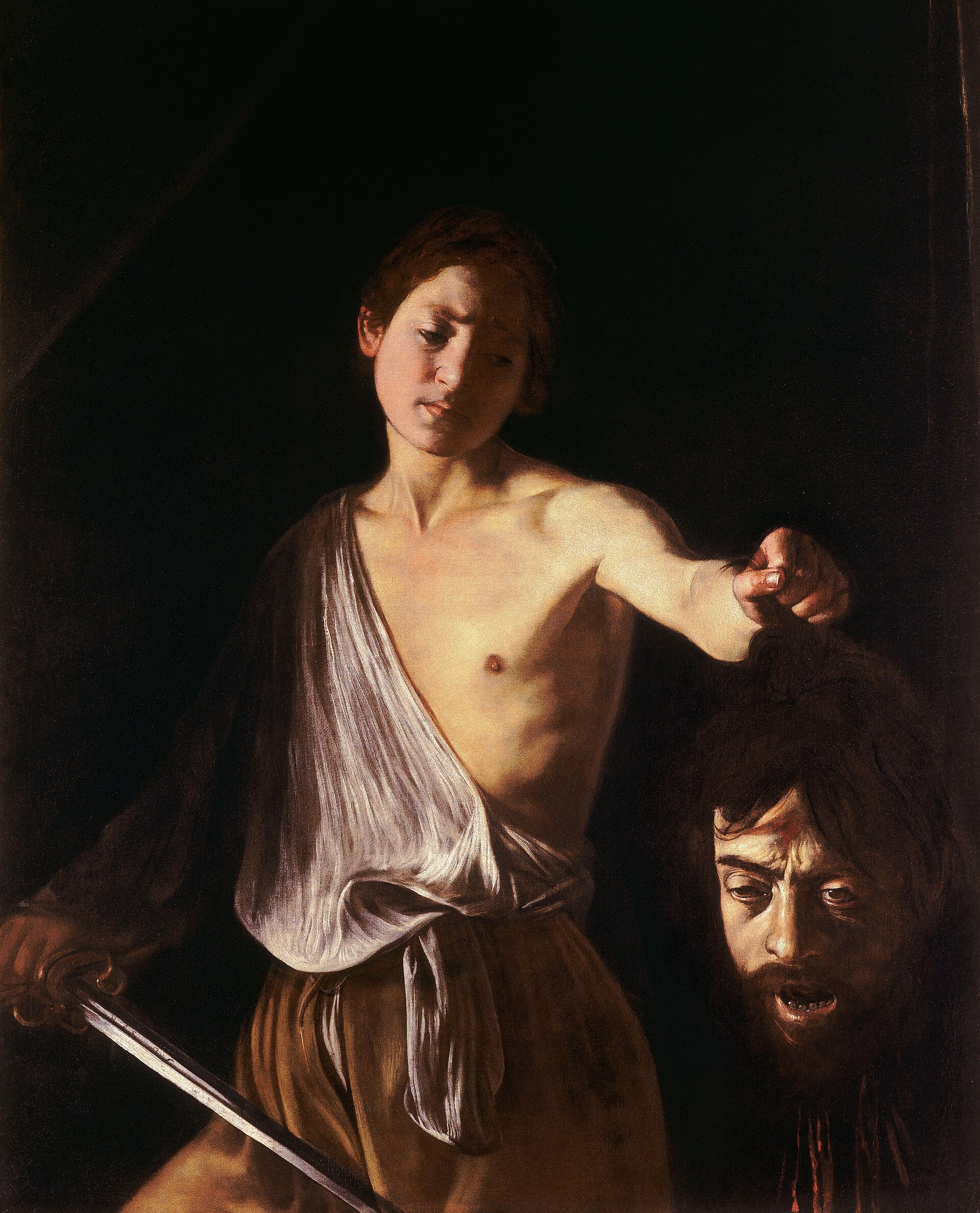
Caravaggio, David with the Head of Goliath (c. 1610), Galleria Borghese, Wikimedia Commons, public domain.
The one who excuses the artist's wrongdoing for the sake of his genius is in denial in much the way the artist is. The audience uses the greatness of the work to keep from knowing what the artist did, while the artist leans on that greatness to avoid looking at himself, so both of them keep their eyes on the work, and the audience excuses him on the same grounds he uses to excuse himself, which is the greatness of what he made.
Wounds and the persons they make
Some artists come out of lives so damaged, by trauma or by an illness that bends how the world reaches them, that it can seem unfair to ask the same of them as of anyone else, especially when the damage may be part of what makes their work possible. Karl Jaspers, who was a psychiatrist before he was a philosopher, argued in his study of Strindberg and Van Gogh that illness could open a person to experiences that then found their way into the work, while insisting that the spiritual worth of what they made could never be reduced to the sickness itself[19]. I think Jaspers is right about what illness can open, but a character is built over years out of choices a person keeps repeating, and Aristotle held us responsible for our characters for that reason, so the artist still answers for the man he became. Adults living with mental illness are also more likely to be victims of violence than to commit it, so an illness on its own tells us little about who will do harm.
Kusama grew up under an abusive mother and spent the last decades of her life in a psychiatric hospital in Tokyo by her own choice, and through all of it she harmed no one. Maya Angelou was abused as a child and stopped speaking for almost five years, and out of that silence came I Know Why the Caged Bird Sings. Louise Bourgeois spent most of her life working through her father's betrayal of the family in her sculptures. Edvard Munch lost his mother and his sister to tuberculosis, grew up under his father's grim religion and broke down in 1908, and that grief and dread run through The Scream and the sickroom paintings. On the other side stands Michael Jackson, whose father beat him through his childhood and who as an adult faced accusations of abusing children, settling one case in 1993 and being acquitted in another in 2005. Caravaggio lost his father to the plague as a child of six, killed a man in Rome in 1606 and spent his last years running from it.
Caravaggio is the hardest of them to place. He killed a man and was jailed in Malta two years later after a brawl in which knights of the Order were wounded, and yet in the head of Goliath he painted his own guilt in the open. Setting these lives side by side, I cannot find a wound that decided what the person would become. Kusama, Angelou and Jackson were all harmed as children, and Jackson's childhood was further bent by an industry that put him to work on stages before he was ten, yet if the accusations against him are true, he is the only one of them who went on to harm children, a difference that came from choices he made over many years.
Consumed by the work
The excuse we make for gifted people has a cinema of its own, films that love to tell the story of an artist chasing perfection and teach their audiences, scene by scene, that whatever greatness costs is worth paying. In Black Swan Nina gives herself so completely to the role that it eats her, and the film ends with her bleeding from a wound she gave herself, whispering that she was perfect, and in Whiplash Andrew's hands bleed onto the drum kit under a teacher who believes that no two words do more harm than "good job," and the film ends in a triumph so overwhelming that it is easy to forget it was paid for with abuse. Birdman takes it furthest, with Riggan shooting himself on stage and a critic hailing it as a new kind of realism. These films invite us to admire an artist destroyed by his work, which is why I called this genre, in my essay on Kokuho Two Inscriptions, a kind of meritocratic theodicy, a story that makes suffering into the price and the proof of genius, and an audience raised on that story is already half ready to excuse the gifted wrongdoer, since the films and the excuse both ask us to accept that greatness makes up for the harm.
Kokuho differs from these films, because there the artist survives and other people pay, the women his art needs to forget and the child crying for a father who will not turn around, and the national treasure he becomes is built on what was taken from them. The other films keep that moral cost offscreen, and it is the cost the gifted wrongdoer passes on to the people around him.
Hokusai gave himself to his work as completely as the actor in Kokuho, inside the same culture of masters and long apprenticeship, and the life he built around it took far less from other people. He made cheap woodblock prints and picture books for the townspeople of Edo, stayed poor for most of his life, and moved house more than ninety times, while his daughter Ōi painted beside him as an artist in her own right. In his seventies he began signing his work as "the old man mad about painting," and in the preface to One Hundred Views of Mount Fuji he wrote that nothing he had drawn before seventy was worth much and that he hoped every dot and line would be alive by the time he reached a hundred and ten. On his deathbed he is said to have asked for five more years so that he could become a real painter.
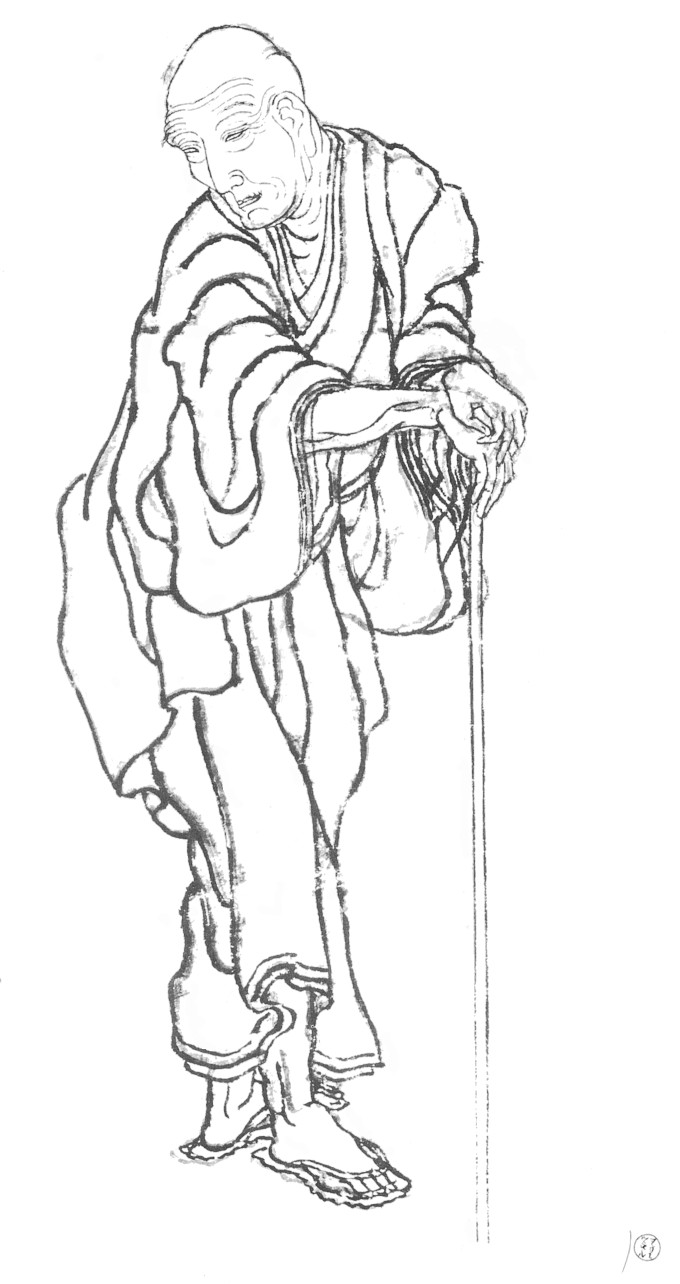
Katsushika Hokusai, Self-Portrait as an Old Man (1839), Louvre, Wikimedia Commons, public domain.
The one who speaks in his defense
In a clip that spread online, Anya Taylor-Joy said that women don't method act because they have things to take care of and cannot completely lose their minds, and she drew the line at actors who treat their immersion in a role as permission to be "assholes" to the hundreds of people working around them. Method acting can serve as an excuse because it presents itself as devotion to the work, and from the outside no one can tell whether an actor is lost in his character or hiding behind it so he can mistreat the people who help make the film. A wider version of that excuse turns up on social media every time a talented artist is caught treating others badly, where his talent is supposed to earn him a pass, and the people defending him often sound proud of their honesty. Who is that excuse protecting?
Whoever defends a talented artist on these grounds is confessing something about himself, since the permission he gives was settled in him long before he said it, a way of keeping the pleasure of the work while whatever he knows about its maker stays somewhere he never has to look. That habit of not looking works against the art itself. The artist, as I described him earlier, is an ordinary person who drank from the mysterious well and came back carrying what the collective consciousness refuses to see, and the one who makes this excuse stands at that same well and covers it, hiding the thing the work he loves was trying to show him, so that his love for the art and his excuse for the artist pull against each other even as he speaks.
Covering the well this way carries the artist's own split into his audience. Like Jekyll and Hyde, the gifted wrongdoer keeps the self that makes the work apart from the self that harms, and an audience who decides the gift is enough divides himself along the same line, keeping the art in one room and what he knows about its maker in another. He becomes a smaller copy of the self-deluded artist, someone who knows enough about what was done and uses that knowledge to build the reasons he needs to keep returning to the work.
A word of caution: this is easy to confuse with the more ordinary habit of separating the art from the artist, and the two sit close together. What gives the excuse away is that it hands down a verdict on the person and clears him, while someone who separates the work from its maker can still condemn the maker completely, and in practice the line blurs, since the one who separates keeps streaming and the estate keeps earning and the name stays polished. What decides it for me is whether the audience keeps what he knows in view while he listens or separates the two so that he can forget, and the second is the same denial as the defender's, only more polite.
"It's okay to be evil if you're talented"
Georgie titled her Substack essay "It's okay to be evil if you're talented," in her newsletter Cannibal Culture, and to be fair to her she does not mean it as a permission. Her essay is closer to a confession, an account of the old bargain in which we overlook what extraordinary people do in private so long as they keep giving us culture, and of how her own generation calls out bad behavior loudly and then keeps listening anyway, which she admits about herself when she walks out of the Michael Jackson biopic uneasy and spends the next day with his greatest hits on repeat, and when she confesses she might have liked the reply that asked whether the women Ariana Grande hurt had ever written Dangerous Woman. She repeats the excuse with her eyes open, which is already half of what I have been asking of the audience, since she keeps the knowledge in the room even while the music plays.
I agree with her when she notices that "the genius exception turns into the wealth exception," that the artists we excuse are rarely starving in an attic and are usually "comfortable, rich and powerful," "a new form of nobility" placed "above ordinary accountability," and she ends by asking "why does that exemption only ever go upwards." Orwell named the same privilege eighty years earlier when he called it benefit of clergy, and what her question adds is the market around it, the labels and estates and streaming numbers that keep the privilege paid for long after the scandal has been reported.
Where I part with her is the turn to psychology. She leans on the Dark Triad, narcissism, Machiavellianism and psychopathy, and on research suggesting a small link between these traits and creativity, with narcissism the strongest[20], and she concludes that "the same wiring" that produces the work also produces the affairs and the temper, that "somewhere, sometimes, the wires get crossed." The correlations in that research are small and lean heavily on people rating their own creativity, and as far as I know studies such as the one by Jack Goncalo and his colleagues in 2010 found that narcissists judge themselves more creative without producing work that others judge more creative[21], which is a finding about the ego claiming credit for gifts it does not measurably have. Her source is a popular explainer, and I think the larger trouble is what popular psychology does to an argument like this one. A label such as the Dark Triad sounds scientific even when the evidence behind it is thin, and once a person's harm is described as wiring, we stop asking whether he chose it, and the old excuse for talent comes back sounding like science. She does keep choice in view when she writes that "you can be a creative genius without being a bad person" and asks whether it takes "more work to be good," but the Dark Triad pulls against her own question, and a reader can easily take it as one more reason to excuse the gifted.
Her question deserves an answer, and I think the answer is yes, it does take more work to be good. Aristotle thought so too. In the second book of the Nicomachean Ethics he writes that "it is no easy task to be good," since anyone can get angry or give money away, but to do it "to the right person, to the right extent, at the right time, with the right motive, and in the right way, that is not for every one, nor is it easy," which is why goodness is "both rare and laudable and noble."[22] He also held that "men become builders by building and lyre-players by playing the lyre; so too we become just by doing just acts," and an artist should recognize this better than most, since he already knows that a skill is built over years of practice that no gift excuses him from. The gifted artist who lets his talent stand in for his character expects to be good without the practice he would never skip in his own craft.
The audience's share
An audience who keeps returning to the work is still not guilty of what its maker did. Writing to postwar Germany in 1946, Jaspers separated the criminal guilt that belongs only to the one who committed the act from the moral guilt that falls on those who looked away[23]. I have charged the artist with an unveiling that stops at himself, and if I examined him while leaving the audience alone I would be doing the same thing, so the audience's share gets weighed here too, even though it is the smaller one.
Jaspers also named a political guilt that everyone living under a system shares for what its institutions do in their name, even those who never lifted a hand, and the audience faces something like it. The "new form of nobility" Georgie describes is kept there by labels, estates and studios that profit from a clean name, which is how a Michael Jackson biopic can leave the allegations out. Streaming platforms help by playing a song the moment we reach for it, before we have time to remember what we know. Max Weber described charisma as an authority that floats free of ordinary rules[24]. Pierre Bourdieu described how institutions consecrate a person into a name that seems to stand above judgment[25]. The music business has learned to produce both, so the audience who wants to keep what he knows in view is working against an industry that profits when he forgets. The audience's share stays its own, and it still does not make anyone in the audience guilty of what was done, but honest listening now includes knowing where the money goes when I press play, since the royalties keep flowing whatever I think while I listen.
Say there is an album that got me through the worst stretch of my life, the kind I played when nothing else could reach me and the world had closed itself off, and years later I learn that the man who made it did something unspeakable, an assault or something like it that would end any career that was still running. I can stop listening, and that is honest, or I can keep listening, which can be honest too as long as what I now know stays in the room with me while the record plays. What I cannot honestly do is keep listening by making myself forget what he did, and I doubt I could keep the same fondness either, because if what I know changes what the work means then the fondness has to change with it. The help the music gave me was real and belongs to my own history, so my fondness can stay with that part of my life without reaching as far as the person who made it.
It is something like a novel I have loved for years, the one I reread through every bad season, and then learning that its author lifted whole passages from a writer who died unknown. The book still moves me the way it always did, and nobody could blame me for rereading it, but if I keep pressing it on friends as his brilliance and never mention the writer he took from, then I am the one hiding something, and that silence is what the defender of the gifted wrongdoer offers. My silence does nothing for the writer he robbed, and all it protects is my own enjoyment of the book. Claire Dederer, in Monsters, calls that kind of knowledge a stain, something that seeps into the experience whether we invite it or not, and she is honest that the love does not simply switch off[26].
There are cases where the stain is in the work itself, where the harm went into the making and stayed there on the screen. Léa Seydoux called the shoot of Blue Is the Warmest Color "horrible," with its ten-minute sex scene shot over ten days, and Julie Maroh, who wrote the graphic novel the film was drawn from, called those scenes "a brutal and surgical display" of "so-called lesbian sex, which turned into porn"[27], and that film won the Palme d'Or. Here the viewer cannot even claim that the work and the wrong are separate things, because what the actresses describe is what we are watching. A harm done in the making can leave its trace in what was made, and then the work we point to as the reason to forgive the artist becomes evidence against him. I would not claim this happens every time, since Caravaggio and Sade left work whose power no one seriously denies, but it happens often enough that we can no longer weigh the gift against the harm as if the two were separate.
Transgression and concealment
Someone could answer all of this by saying that an artist who unveils what the collective denies will always look evil to it, the way Antigone looks like a criminal to Creon, and that the talented people we condemn are only paying the price for seeing further than the rest of us. Antigone, though, defies Creon's order to leave her brother unburied and then admits it to his face, accepting the punishment that follows. Ai Weiwei took a similar risk when he investigated the government's cover-up of the schools that collapsed in the 2008 Sichuan earthquake and criticized the state in public under his own name, and in 2011 he was held for 81 days. The harms we are asked to forgive in gifted artists are done in secret and last only as long as they stay hidden, kept out of sight by settlements, by silence, and by an audience that would rather not know.
Roman Polanski pleaded guilty in 1977 to unlawful sex with a thirteen-year-old girl, fled the United States before he could be sentenced, and spent the following decades working in Europe, defended by people who loved his films. When Swiss police arrested him on the old warrant in 2009, 138 people in the film industry, among them Martin Scorsese, Woody Allen and David Lynch, signed a petition demanding his release. The petition said it objected only to the way he was arrested, on his way to a festival that was honoring him, and it said nothing about what he had done, though it still asked the courts to free him at once. If I put myself in the place of one of those directors, I can see how easy the signature would have been. Polanski was one of their own, a celebrated director in the same industry, the arrest happened inside the festival world they all moved through, the case was thirty-two years old, and siding with a fellow artist against a prosecutor would have felt like loyalty to their own kind. None of those reasons asks the signer to think about the thirteen-year-old at the center of the case, which is the same turning away I have described in the audience. These signers, though, had a standing that most of the audience lacks, and their names lent public weight to the argument for letting him go while the courts decided whether to send him back.
Lynch is the artist I began this essay with, and nothing I know of his life shows him hiding a deceitful persona. His name on that petition comes from the part of him that was also an audience, and it shows that loving an artist's work can lead even a careful and honest person to look past what that artist did. According to his daughter, he came to regret signing it once she confronted him about it, which tells me he was willing to look again. I loved Lynch's films enough to write about him the day he died, so the discipline I have been asking of everyone else applies to my reading of him too. His signature on a petition to free a man who had pleaded guilty to unlawful sex with a child now stays with me when I watch his films, and it narrows how far my admiration for him can reach.
The Picture of Dorian Gray
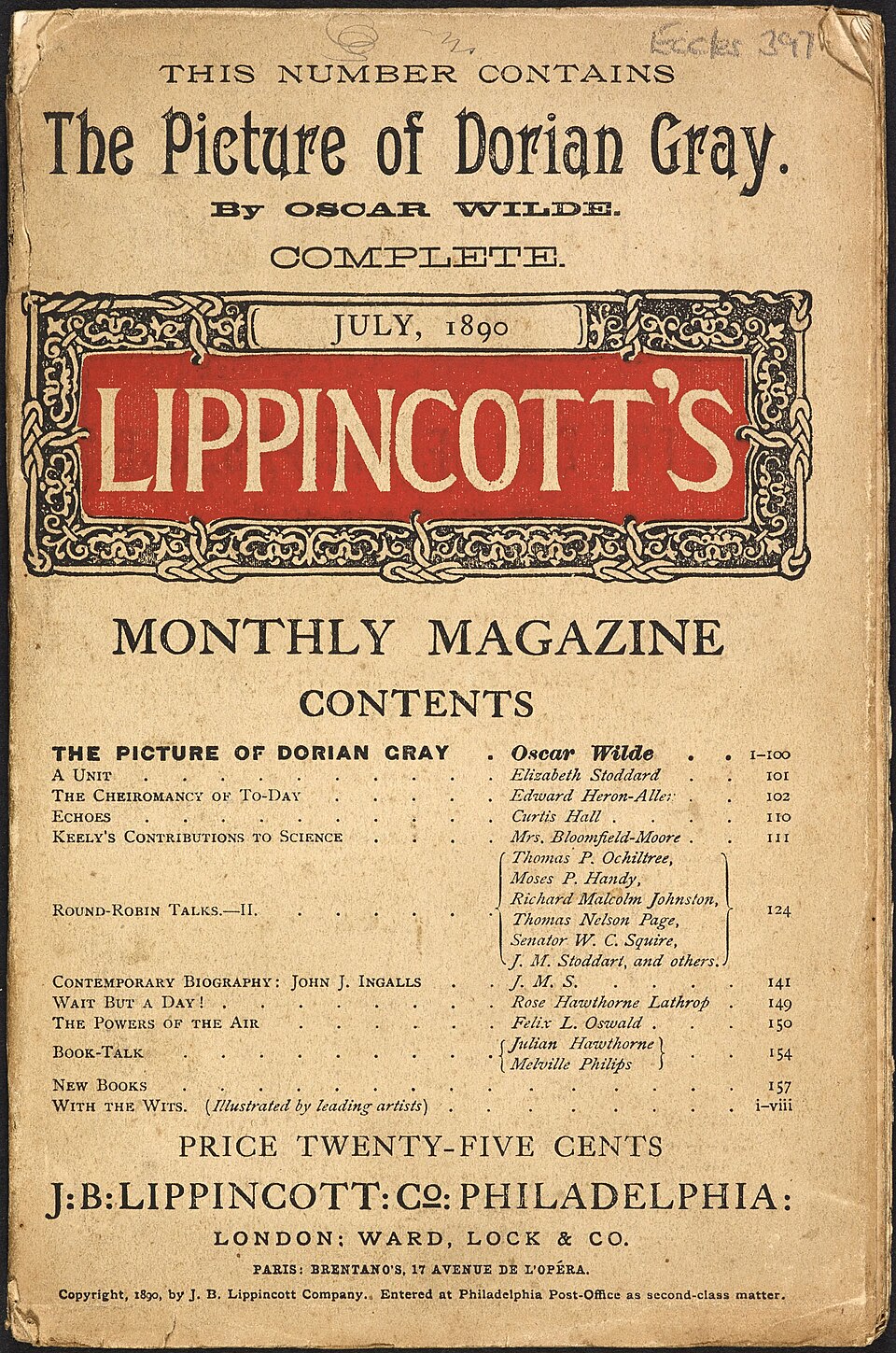
The Picture of Dorian Gray in Lippincott's Monthly Magazine, July 1890, Wikimedia Commons, public domain.
In Oscar Wilde's The Picture of Dorian Gray, a young man wishes that his portrait would grow old in his place, and the wish comes true, so that every cruelty he commits shows up on the canvas while his face stays as beautiful as the day Basil Hallward painted it. He locks the portrait in an upstairs room and goes on living among people who see only the face. The gifted wrongdoer turns this arrangement around. His work is the face he shows the public, and it stays beautiful however he lives, while the cruelty collects in the life he leads away from it, among the people who knew him and were harmed by him. The audience that repeats the excuse looks only at the work, as Dorian's friends looked only at his face, and treats its beauty as proof that nothing ugly is kept anywhere else.
Wilde wrote in the novel's preface that "there is no such thing as a moral or an immoral book,"[28] yet the novel ends with Dorian stabbing the portrait and his servants finding a withered old man dead on the floor beside a painting restored to its beauty, and the story would not let the man and his picture stay apart forever.
I cannot weigh a great work apart from the life of the person who made it. The gift can still give a work its beauty, and I do not think a murderer's paintings stop being beautiful once we know what he did, but the value I give a work also depends on whether the artist was willing to look at himself as closely as he looked at the world, and to change how he treated the people around him because of what he saw. When he refused to look at himself, his talent became the place where he hid his wrongs, and an audience that repeats the excuse joins him in hiding them each time it chooses the work over what it knows about the person who made it.
How far that knowledge should change my response depends on where the failing sits. When an artist fails in an ordinary way and says so in public, as Lynch did when he admitted he had been selfish as a father and husband, I can still say the work is great while holding back the admiration I would give an artist whose life matched it. When the harm has been kept out of sight behind the talent, as the accusations against Jackson would have it, I can still return to the songs, but only if I stop treating them as a reason to excuse him and let what I know limit how far my love for the music reaches toward the man who made it. The hardest case is the one where the harm happened in the making of the work, because the beauty in front of me came out of what was done to the people who helped make it, and I cannot take in the one without taking in the other.
It is not okay to be evil if you are talented, since a gift gives no one permission to harm the people around them and a great one leaves the artist fewer excuses than most of us have. The audience still has work of its own once that is settled, because each time we return to a song or a film we decide what we will let ourselves forget about the person who made it, and that decision shapes how we stand toward the work and toward the artist as much as anything the artist did. I want to keep returning to what moves me while carrying what I know about its maker in with me, and to let that knowledge decide how much of my admiration the artist is still owed.
Sources
- Georgie, "It's okay to be evil if you're talented," Cannibal Culture, 23 May 2026: Substack newsletter
- Kael Espino, "Great Art as a Referential Object Towards Human Nature": enjambments.com
- David Lynch, the Polanski petition and his daughter's account: Wikipedia
- David Lynch, "you gotta be selfish": The Irish Times
- Kael Espino, essay on Kokuho: Two Inscriptions
Viktor Shklovsky, "Art as Technique" (1917), in Russian Formalist Criticism: Four Essays, trans. Lee T. Lemon and Marion J. Reis (University of Nebraska Press, 1965); also translated as "Art as Device" in Theory of Prose, trans. Benjamin Sher (Dalkey Archive, 1990). ↩︎
Simone Weil, "The Love of God and Affliction," in Waiting for God. ↩︎
Friedrich Nietzsche, Beyond Good and Evil, §225. ↩︎
Plato, Laches 188c–189a (Laches on trusting a man whose deeds harmonize with his words, like music in the Dorian mode); Michel Foucault, Fearless Speech (Berkeley lectures, 1983) and The Courage of Truth (Collège de France, 1984). ↩︎
Plato, Republic X, 595a–608b (esp. 597e, imitation as third from the truth; 606d, poetry watering the passions; 607b, poetry banished from the city). ↩︎
Iris Murdoch, The Fire and the Sun: Why Plato Banished the Artists (Oxford: Clarendon Press, 1977). ↩︎
Iris Murdoch, "The Sublime and the Good," Chicago Review (1959). ↩︎
Aristotle, Nicomachean Ethics, III.1, 1109b30–1111b3 (voluntary action, force and ignorance) and III.5, 1114a (responsibility for character); Book II (virtue as habit). ↩︎
Immanuel Kant, Groundwork of the Metaphysics of Morals (1785), Second Section, Ak. 4:421–423 (perfect and imperfect duties, with the footnote at 4:421; the duty to cultivate one's talents at 4:422–423). ↩︎
Immanuel Kant, The Metaphysics of Morals (1797), Doctrine of Virtue, §14, Ak. 6:441 ("know yourself" as the first command of all duties to oneself). ↩︎
George Orwell, "Benefit of Clergy: Some Notes on Salvador Dalí" (1944). ↩︎
Robert Jay Lifton, The Nazi Doctors: Medical Killing and the Psychology of Genocide (New York: Basic Books, 1986), ch. 19, "Doubling: The Faustian Bargain," 418–465. ↩︎
C. G. Jung, Aion, ch. 2, "The Shadow" (Collected Works 9ii). ↩︎
Jacques Lacan, The Four Fundamental Concepts of Psychoanalysis (Seminar XI, 1964). ↩︎
Jacques Lacan, "Kant with Sade" (1963), in Écrits; Marquis de Sade, The 120 Days of Sodom (1785). ↩︎
Emmanuel Levinas, Totality and Infinity (1961), trans. Alphonso Lingis (Duquesne University Press, 1969), Section III.B, "Ethics and the Face," 199. ↩︎
Hannah Arendt, Eichmann in Jerusalem: A Report on the Banality of Evil (1963), ch. 8, "Duties of a Law-Abiding Citizen." ↩︎
Iris Murdoch, The Sovereignty of Good (1970). ↩︎
Karl Jaspers, Strindberg and Van Gogh (1922). ↩︎
Peter K. Jonason, Emma N. Richardson and Leith Potter, "Self-Reported Creative Ability and the Dark Triad Traits: An Exploratory Study," Psychology of Aesthetics, Creativity, and the Arts 9, no. 4 (2015): 488–494, doi:10.1037/aca0000037. Georgie's own source is a popular explainer, Psychology Today, "Dark Triad". ↩︎
Jack A. Goncalo, Francis J. Flynn and Sharon H. Kim, "Are Two Narcissists Better Than One? The Link Between Narcissism, Perceived Creativity, and Creative Performance," Personality and Social Psychology Bulletin (2010). ↩︎
Aristotle, Nicomachean Ethics, trans. W. D. Ross (Oxford: Clarendon Press, 1908), II.9, 1109a24–30 ("no easy task to be good"); II.1, 1103a31–b2 (builders, lyre-players, and just acts). ↩︎
Karl Jaspers, The Question of German Guilt (1946). ↩︎
Max Weber, Economy and Society, on charismatic authority. ↩︎
Pierre Bourdieu, The Rules of Art (1992), on consecration. ↩︎
Claire Dederer, Monsters: A Fan's Dilemma (2023). ↩︎
Julie Maroh, blog statement on the film adaptation of Blue Is the Warmest Color (2013). ↩︎
Oscar Wilde, The Picture of Dorian Gray (London: Ward, Lock and Co., 1891), Preface; ch. 20 for the ending. ↩︎
From here
- 2025-01-17 / On the death of David Lynch.
- A Journey into the Self / Eight principles of limitation and the Dantean descent.
- In Praise of Deliberate Decisions.
- Great Art as a Referential Object Towards Human Nature / Dissecting the human while keeping it alive.
- On Experiencing Art / Time, authenticity, and the blood pact of creation.
Kael Espino. “Separating the art from the artist, and the moral responsibility of artist and audience.” enjambments, Nov 18, 2026. https://enjambments.com/thoughts/separating-the-art-from-the-artist-and-the-moral-responsibility-of-artist-and-audience/
@online{espino2026separating,
  author = {Kael Espino},
  title = {Separating the art from the artist, and the moral responsibility of artist and audience},
  year = {2026},
  date = {2026-11-18},
  url = {https://enjambments.com/thoughts/separating-the-art-from-the-artist-and-the-moral-responsibility-of-artist-and-audience/}
}
All 8 connections
- 2025-01-17 · On the death of David Lynch
- A Journey into the SelfEight principles of limitation and the Dantean descent
- In Praise of Deliberate Decisions
- Great Art as a Referential Object Towards Human NatureDissecting the human while keeping it alive
- On Experiencing ArtTime, authenticity, and the blood pact of creation
Select any words to keep them
One letter a month
Reader
- Essays a few days early (every essay stays public)
- Your name in the acknowledgements, if you want it
Interlocutor
- Everything in Reader
- First claim on prompt requests, one each quarter
- A word from me when the piece is done
You have read the whole path