re_Locations
It has been a month dedicated to preparing all the things that we need to move out of the metro. Packing rarely used items in the apartment: some clothes in boxes, disassembled light accessories, some musical instruments collecting dust, some words that I have told to my family about the idea of me leaving, and other memories of the city that allowed me to keep going this far. It is liberating, to say the least. It is almost as if I am putting an end to the plateauing growth of my old self that once desired to be swallowed by the city—to fully experience its being: a fertile ground for new experiences, the randomness of strangers, and surrendering my whole self to chance, letting the algorithm of the city dictate the psychology of the future person I want to be.
Then, I realized that it was my overdue youth who was speaking. This desire to become one with the city was the dream of a person who I once was. This idea that what I think I want is not mine is caused by years of working remotely. I stopped going out of the apartment every day because of necessity. While working from home, the city provided everything I needed and with apparent convenience. A 5-minute walk to a supermarket, less than an hour away from every restaurant for delivery and takeout, 10-minute drive to parks and open spaces, which all sounds incredible at first, but everything gradually fades into triviality when the reality is that I do not need to go out that often since me and my partner both are working from home.
Last Saturday, I went to Calamba to work on transferring our ISP to the house we are moving into. I took that as a chance to survey and walk the streets of the future city we will be residing. I would say that there is no stark difference in appearances when the atmosphere in Calamba is an amalgamation of every small thing that I have seen and felt while living in the metro. The humbling presence of small sari-sari stores beside the sidewalks, the roving tricycles on the main road beside jeepneys, private vehicles, and provincial buses, the sight of people in their homey clothes populating the mall, the crowded scene of a dry and wet market, its noise and the unpretentiousness of each person—everything is all familiar and similar yet different at the same time.
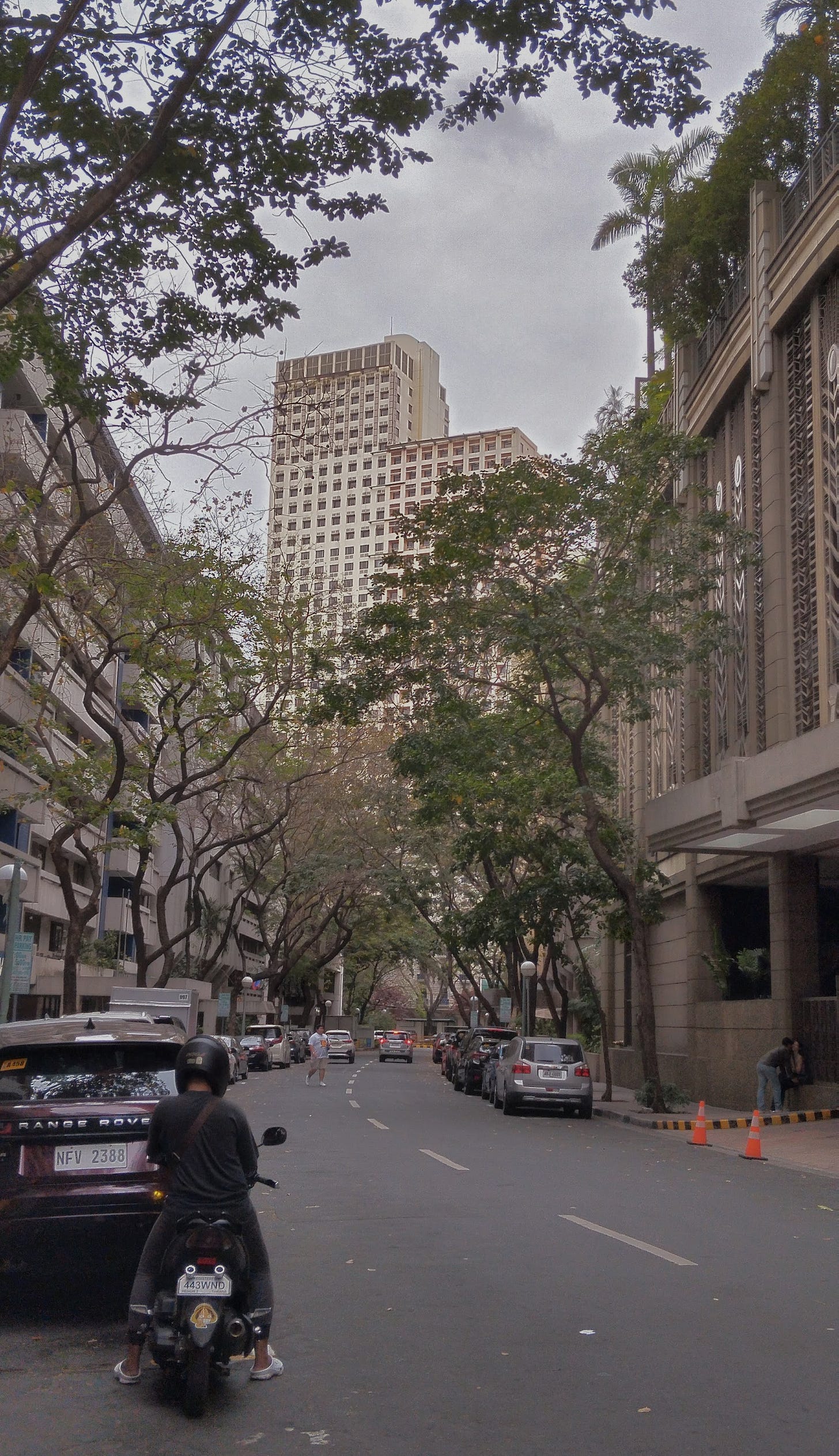
Perea St. Legazpi Village, Makati
On the same day, on my way back home in the metro, I dropped by Makati to walk the same streets I used to. The same streets that filled me with hope for tomorrow, the myopic verticality of streets that obfuscates the sky with concrete jungle, its towering Mecca of high-rises for the corporate pilgrims that filled the streets of rush hour traffic, where most dreams die in favor of borrowing time to survive for another day. I used to pray in this city wanting to live in one of those buildings, seeing the night lights, feeling secure that the city watches over me while I sleep at night, wishing for myself not to turn into one of the zombies that walk the same streets I revere with rose-colored glasses bought from the nearby posh malls for the rich.
Then—I felt a temporal disconnect. Suddenly, this city becomes different from what I once desired. Seeing a new and younger generation of people populating the city made me feel like an outsider in this new and emerging religion. It felt like a new language was brewing inside, in which I was not a part of creating. The city is an old phrase spoken in a new tongue. Old stores have been replaced by newer and modern-looking coffee shops. The strategically placed convenience stores are now empty and being renovated into something else. The faces are becoming younger and younger with every step I take. The city is phasing into a different time that does not recognize me. It is becoming the future; the dream younger people probably have but not the dream my younger self envisioned it to be.
The message becomes clear. What I felt was a confirmation of my intuition to move away from the metro. I have graduated from the illusion of prosperity, and it is time for me to move on to a place where I will not regurgitate the same memories in the same place and actually make new ones that will define me for the next decade.
Calamba felt like coming home not to where I once was but to where I wanted to be. It felt like making a home for myself, whose desires are not easily swayed and dictated by the materialistic externalities of my youth. It felt like a palpable departure from the illusion and more towards something real, concrete, and difficult. I know that this is a place where I can create and temper my own meaning.