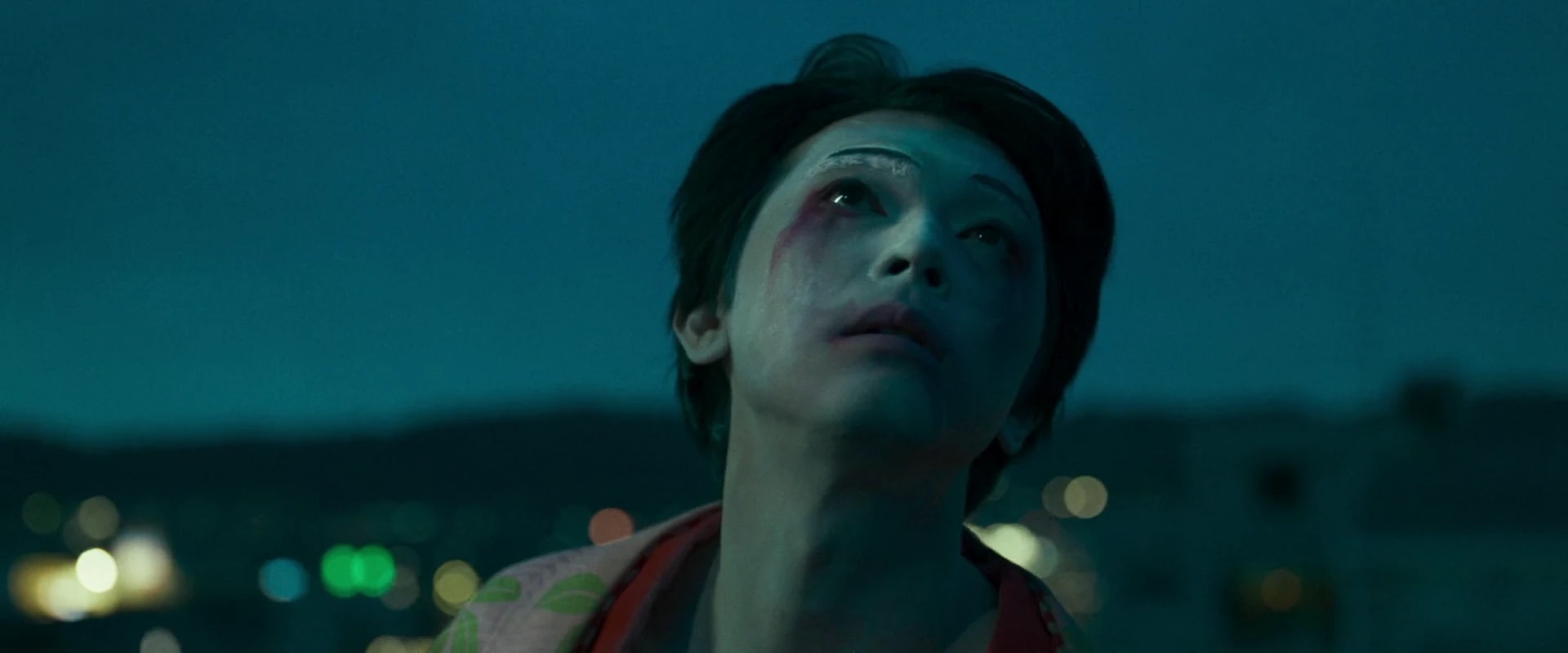
Kokuho, Two Inscriptions
Kabuki, the idealized feminine, and the mark of lineage
reading now kept times
Lee Sang-il's Kokuho: yakuza ink under onnagata paint, femininity staged for male lineage, and a state-certified beauty that others pay for.
thoughtNov 23, 202626 min readartmediaidentitysociety
Lee Sang-il's Kokuho: yakuza ink under onnagata paint, femininity staged for male lineage, and a state-certified beauty that others pay for.
Two marks on one body
Lee Sang-il's Kokuho (National Treasure, 2025) follows fifty years in the life of Tachibana Kikuo, a gang boss's son from Nagasaki who becomes the most celebrated onnagata of his generation. From its opening sequence, the film sets two marks on his body, a yakuza tattoo and the white paint of the onnagata, and these become its central contrasting images. The tattoo on Kikuo's back marks his lineage, a sign of clan and oath worked into the skin with indelible ink and with an inescapable sharpness of pain. The white paint masks the body for the length of a performance and carries a femininity that lasts only as long as the paint does, one that has to be perfected to be worth anything. For most of his working life the paint is laid over the ink, and I read the film as the story of what each does to the other.
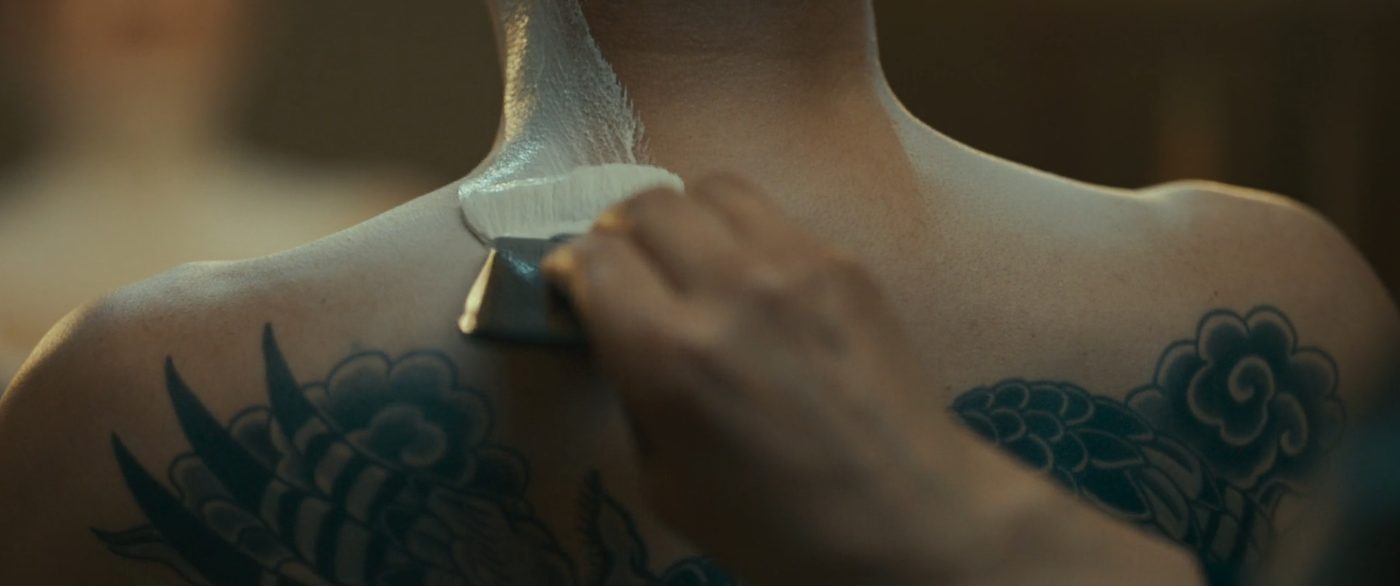
White paint brushed on above Kikuo's tattoo. Kokuho (Lee Sang-il, 2025).
The film introduces both marks on a single night. It opens at a New Year party in Nagasaki in 1964, where the boy entertains his father's men and their guest, the kabuki star Hanai Hanjiro, with a scene from Seki no To (Tsumoru Koi Yuki no Seki no To, "The Barrier Gate in the Snow of Accumulated Love"), playing the courtesan Sumizome, the spirit of the Komachi cherry tree, in her meeting with the barrier keeper Sekibei, quick costume change included. Shortly afterward, as heavy snow falls over Nagasaki, a rival gang raids the house, and Kikuo watches his father fall in the courtyard, his tattooed skin bared and his blood scattered across the snow.
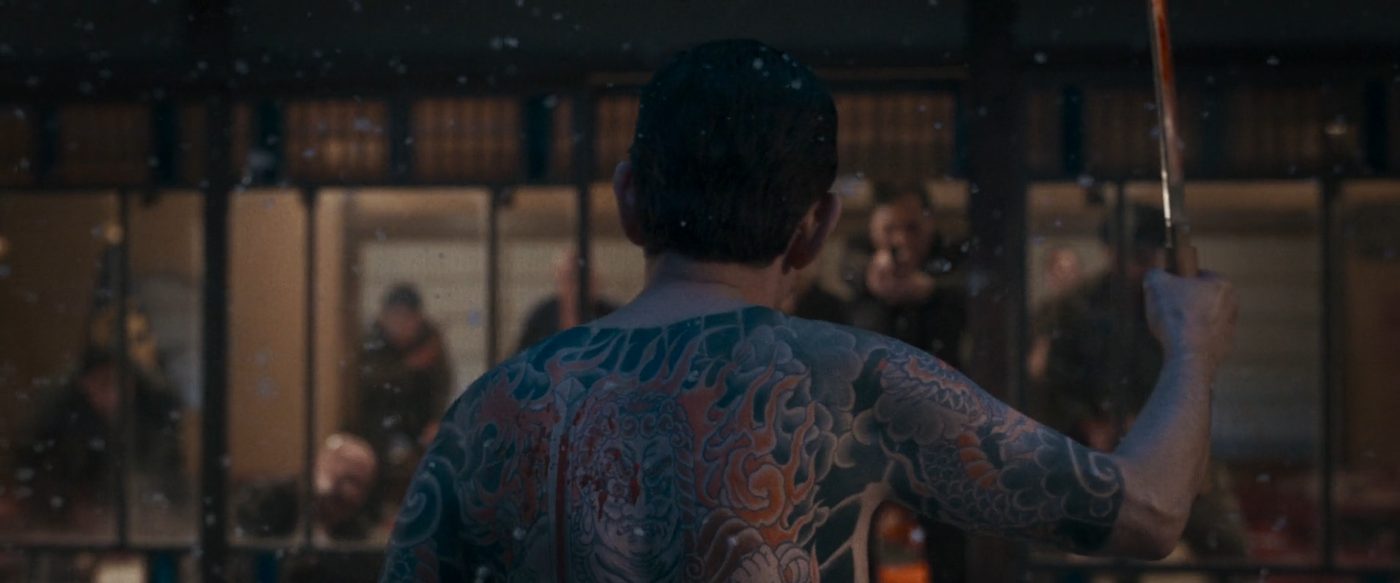
Kikuo's father in the courtyard on the night of the raid. Kokuho (Lee Sang-il, 2025).
The coloring of that courtyard, the snow and the blood on it with the father's inked skin between them, is also the palette of the onnagata's face, a white base with red at the eyes and lips. Whether or not Lee meant the rhyme, I think Kikuo's mind held on to the colors of that night, and every time he paints his face he puts them back on.
I came to the film wanting to know what the "performance of femininity" says about the men who perform it: the gentleness, the precision of movement, and the high standard it takes for a man to do it as art. In a sense, gender becomes an art form of its own, defamiliarizing itself from how we usually treat it as an identity. It becomes a deliberate chosen act for an audience. Femininity becomes a desirable ideal through the body of a man. The opening sequence shows where that ideal first appears. Kikuo is first seen as a woman when he is still a boss's son dancing for his father's men, only moments before his father is killed. That first audience is a room of gangsters, and the ideal Kikuo embodies that night arrives in his life together with the violence that ends his childhood. By the end I had a different question: not what understanding the feminine does to a man, but what desiring it does. Why is it desirable to a male performer at all, and what does it cost? What I found is that the film's highest honor goes to two different kinds of beauty under one name, and that the state, the audience, and maybe the film itself can't tell them apart.
Why men play women at all
Kabuki began with women. In 1603 Izumo no Okuni, possibly a former shrine maiden, began performing a new style of dance drama with a troupe of women on the dry bed of the Kamo River in Kyoto, and because the troupes that followed her also sold sex, the shogunate banned women from the stage in 1629.[1] Adolescent boys, the wakashū, took over the female roles, and when patrons pursued them in much the same way, the shogunate banned the boys as well in 1652. The adult men who remained had to keep the adult hairstyle, with the forelock (maegami) shaved, and for much of the Edo period they were forbidden to hide the shaved pate under a wig, so onnagata covered it with a cloth, usually purple, called the murasaki bōshi. The rule was meant to make the actors less attractive, yet the cloth itself became a sign of the onnagata's allure,[2] much as Zeami's principle for the noh stage holds, 秘すれば花なり, "the hidden is the flower."[3]
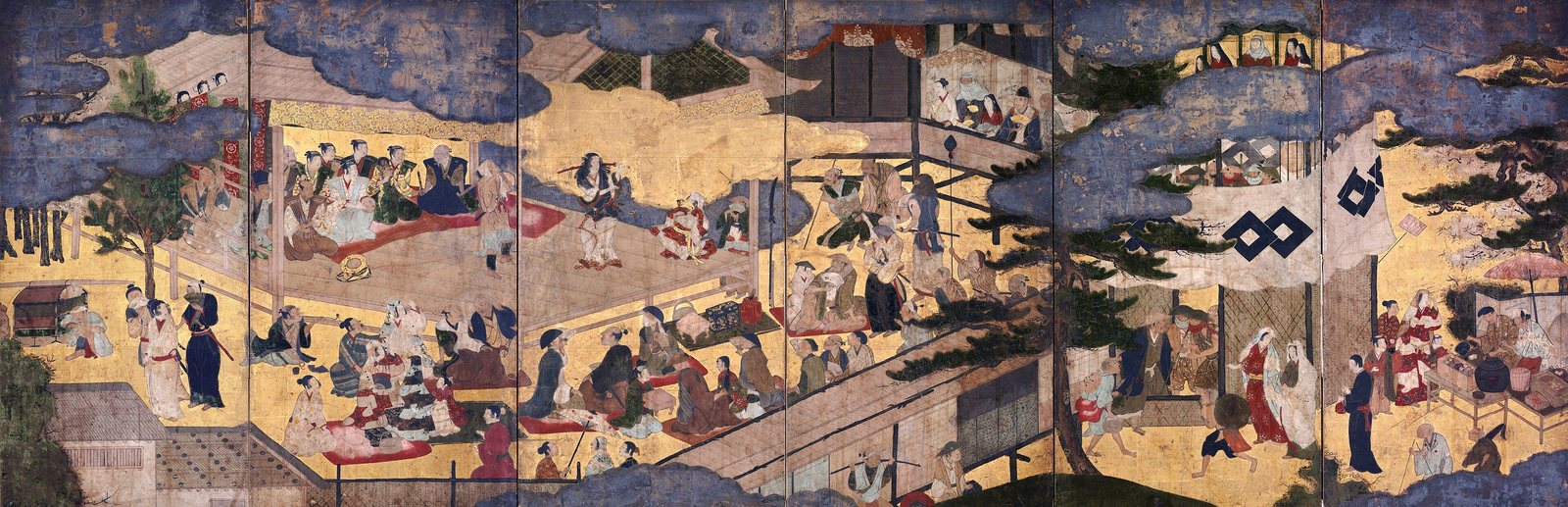
Okuni Kabuki Screen, Momoyama period, early 17th century, the oldest known depiction of Izumo no Okuni, who dances on the stage in the third panel from the left. Kyoto National Museum (via Wikimedia Commons).
Erotic attachment between men did not begin with kabuki. Before the Edo period, nanshoku, "male love," was long associated with the samurai class and the Buddhist clergy, and medieval monasteries housed adolescent acolytes, the chigo, who served under senior monks and were also their sexual and romantic partners; across these settings the desired partner was a wakashū, an adolescent youth.[4] The relationship was organized by age and status between an older man and a youth, with nothing resembling the modern idea of a sexual identity, as Gary Leupp argues in Male Colors: The Construction of Homosexuality in Tokugawa Japan. The bans left that attachment in place, and the theater districts remained centers of male love. Thirty-five years after the ban on boy actors, Ihara Saikaku's The Great Mirror of Male Love (1687) gave its first twenty stories to samurai youths and its second twenty to young kabuki actors, who also served as boy prostitutes in the theater districts of Japan's three great cities.[5]
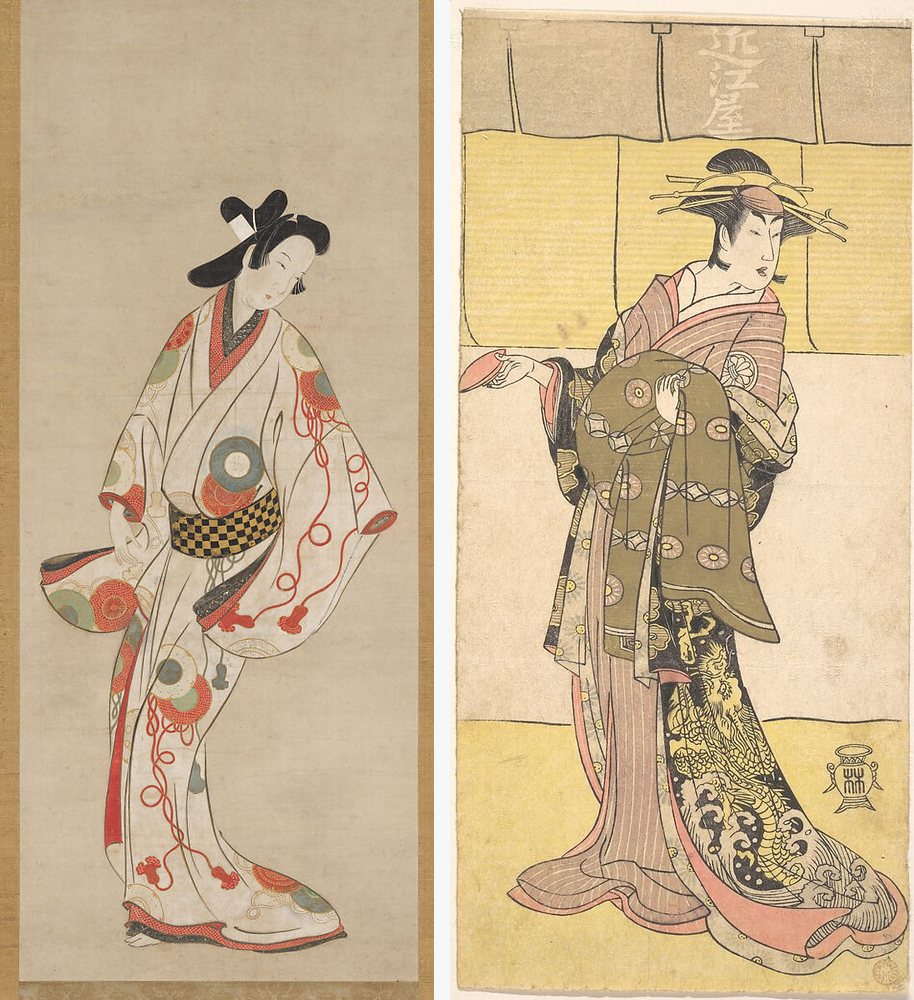
Left: Wakashu (Male Youth), unidentified artist, mid- to late 17th century. Right: Katsukawa Shunshō, The Actor Segawa Kikunojō as a Courtesan of the Ōmiya Brothel, ca. 1786, the forelock covered by the onnagata's cloth. Both The Metropolitan Museum of Art, public domain.
The shogunate kept trying to remove desire from the stage and only ever removed its signs: first the women, then the boys, then the forelock. Desire just moved to whatever was left. Deleuze and Guattari would say desire lacks nothing, that it doesn't wait to be repressed but invests in whatever codes are in front of it.[6] The onnagata is what was in front of it, a femininity made where a forbidden desire met a law that could only take things away, and that figure has been refined and revered for close to four centuries.
Kokuho presents the onnagata's femininity as a pure thing, the product of discipline and devotion, and it is easier to admire it in that form if one forgets that the art was born from a prohibition and that desire never left the stage.
What the paint covers
Hanjiro takes the orphaned Kikuo into his household in Osaka to be raised beside his own son, Shunsuke, and the two boys train side by side as rivals under Hanjiro until they receive the stage names Tōichirō and Hanya and become popular as an onnagata pair. Onnagata technique works largely by subtraction. The shoulder blades are drawn together to narrow the frame, and the knees are bent and held close to lower the body and shorten the walk. Sustaining those adjustments through a long dance takes constant muscular effort. The softness an audience sees is held up by a strain it is not meant to notice.
A role that requires this level of integration fits Jung's description of the persona as "a compromise between individual and society as to what a man should appear to be,"[7] and he warns that a person who identifies wholly with the persona comes to be governed by whatever it pushes out of view. In Kikuo's case what is pushed out of view is the courtyard in Nagasaki. The critic Onodera Kei, writing in Real Sound, connects the scenery Kikuo says late in the film he has spent his life searching for to the snow in which his father died, suggesting that Kikuo may have found the sight of his father's death beautiful without ever being able to say so. On this reading the figure beneath the persona is the memory of a violent death held as an image of beauty, and it entered his life within the same hour as his first female role.
Lee's camera stays on Kikuo's face for long stretches, in performance and outside it, as though behind the white paint there were a whole hidden person whose inner life the film is privileged to watch. The film needs that person, since a structure of lineage and patronage becomes a tragedy only when it happens to someone with an interior to lose, and a good deal of the film's power depends on persuading us that Kikuo has one.
The women the art needs to forget
Four women pass through Kikuo's life. Harue follows him from Nagasaki and leaves with Shunsuke when Hanjiro gives Kikuo the role that should have gone to his son. Fujikoma, a geisha who sees his talent early, bears him a daughter. Akiko, the daughter of the kabuki head Azuma Sengorō, becomes his target after Hanjiro's death, because marrying into her house would secure a position he is losing. Ayano, the daughter he never acknowledged, reappears decades later as a photographer at the side of a father who has become a national treasure. One of the scenes that stays longest is a small one, in which Fujikoma's young child calls out "Otōchan!" to Kikuo in public and he walks on as though he has not heard.
Onodera reads that scene against Mizoguchi Kenji's The Story of the Last Chrysanthemums (1939), in which a kabuki actor presents himself to the public at his name-succession while the woman who sustained him through his years of hardship lies dying, and he argues that the older film's ideal of a woman who withdraws once the man succeeds, presented there as a woman's proper path, helps explain the stance of the women around Kikuo.[8] The geidō film, the film about the way of an art, has long counted a woman's sacrifice among the costs of an actor's greatness. Kikuchi Kan's story "Tōjūrō's Love" (1919) carries the logic further, giving an actor the reflection that for the sake of his art the lives of one or two women count for little.
Mishima Yukio's story "Onnagata" (1957) suggests why the art might require this. Its title character, an onnagata named Sanokawa Mangiku, falls in love with a young director, and the theater man who has long worshipped his art is unsettled less by the love than by what it reveals, that the onnagata's femininity, once it turns toward a real man, stops being pure image. The art depends on its feminine belonging to no one, and Kikuo sets the women in his life aside for much the same reason, since any real attachment would compete with the image he serves.
These women are more than casualties, though. Akiko, disowned by her father for following Kikuo, helps him prepare and carries the heavy luggage through his years on the provincial circuit with a toughness that a second Real Sound essay, on the film's women, reads as something she wanted for herself, a chance to walk by her own will outside a house that had always defined her as a kabuki head's daughter. Whether the film criticizes the pattern it inherits or repeats it with greater beauty is a question I come back to at the end. Onodera answers it for himself, stating plainly that he opposes the idea of reaching beyond the human through inhumanity, which he calls a male-centered, self-serving notion rooted in the cult-like customs of closed industries.
The other women act on their own wills too, if more briefly. Harue chooses Shunsuke over the man she followed from Nagasaki, Fujikoma raises the child Kikuo will not claim, and Ayano returns on her own terms decades later to face the father who walked past her. The film shows each of their choices at the moment it touches Kikuo's art, and then follows him instead of them. In Kokuho the cost of a femininity performed as an art falls mostly on the women who never perform it. I should admit this essay does the same thing: from here on, the women come back mostly as things that happen to Kikuo.
Making the mud
Onogawa Mangiku, played by the dancer Min Tanaka, is the summit Kikuo climbs toward, a Living National Treasure whom Lee has called the film's closest figure to Nakamura Utaemon VI, the great postwar onnagata,[9] and whose name the novelist Yoshida Shūichi took from Mishima's story, changing one character of the surname. When the boys first meet him, Mangiku warns Kikuo that his beautiful face will get in the way if he means to become an actor, and when they watch him dance Sagi Musume they are overwhelmed by a beauty the film presents as close to monstrous. I read the warning as Mangiku's understanding of the onnagata's art. The role has to occupy the actor completely, and a face as striking as Kikuo's keeps an audience looking at the boy himself, so Mangiku sees early that Kikuo will have to give up that face, under the white paint of every performance, before he can become what the role needs.
Late in the film, when Kikuo has fallen as low as he will fall, Mangiku sends for him from his sickbed and asks him to dance, and that request returns Kikuo to the stage. In Onodera's view, Mangiku judges the moment right because Kikuo has drunk muddy water and been thoroughly soiled, and resolves to pass on his own soul in the spirit of the Buddhist image of the lotus that grows from mud. The image has a scriptural source in the Vimalakīrti Sūtra, which observes that lotuses do not grow on high dry ground but only in low wet mud[10] and uses the observation to argue that awakening comes out of the defilements of ordinary life.
The way of art, as the film presents it, alters the sūtra's logic in one decisive respect. The sūtra accepts that the mud is already there, whereas the actor's path in Mangiku's teaching requires him to make it, through ruined relationships and a child he refuses to acknowledge, so that other people's suffering becomes the soil of his art.
I would argue that this is how most artists, in their pursuit of greatness, as a type of obsession, are usually portrayed in media or act in real life. There are sacrifices to be made for greater art, and as less remains to be sacrificed within the self, the people around the artist are sacrificed for the art. That account is also the one a closed industry uses to justify what it does, since once the sacrifice of other people is described as the price of art it begins to look necessary. Onodera points to the old saying in kabuki that an actor's affairs with women are fertilizer for his art (女遊びは芸の肥やし), a habit never written into any rule yet long excused by custom. The route is tragic for the artist, and in Kikuo's case it also makes his ascent as an onnagata harder to admire, since the film gives him a scene at a shrine in which he says, "I was making a deal with the devil, not with God."
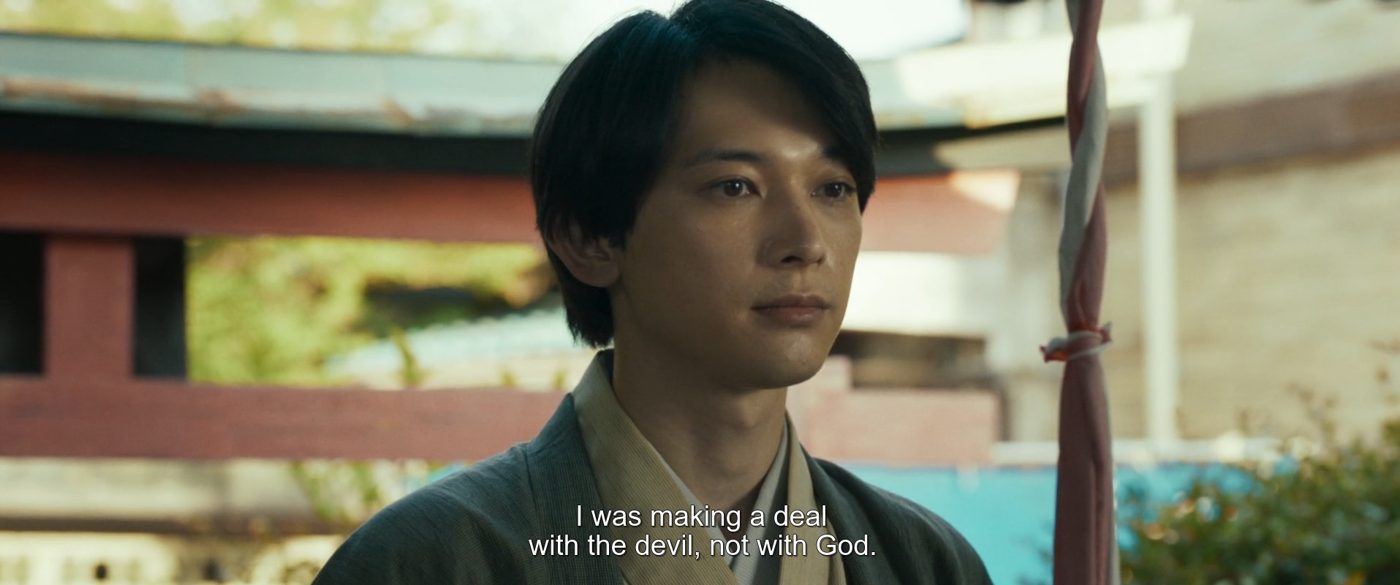
Kikuo at the shrine. Kokuho (Lee Sang-il, 2025).
Kikuo is repeatedly described as empty, karappo, and Onodera suggests that this emptiness is what makes him a fitting vessel for the art, as Mangiku was before him. The word invites an echo of the Buddhist emptiness that frees a self from its own boundaries, though what the film shows is closer to a vacancy. Kikuo was the son and heir of a gang boss, cut loose from that lineage by his father's death and left with an empty place that Hanjiro's house, and later the art itself, could fill. By the time Mangiku sends for him he has been emptied a second time, pushed out of the standing he had won as an onnagata once Shunsuke returned to reclaim Hanjiro's name. Both of the lineages he might have claimed, the clan he was born to and the house that adopted him, had been refused to him by fate. When Mangiku dies, what passes to Kikuo is the art, and his final performance in the film is the same Sagi Musume the boys once watched Mangiku dance. The film's title belongs to that art, which Mangiku carried and Kikuo receives after his death, and the honor the state gives Kikuo at the end goes to the vessel that holds the art at that moment.
What kind of man
The arrangement of the New Year party, a femininity commissioned and watched by men inside the most aggressively masculine world in the film, holds for the rest of Kikuo's life. His femininity is always produced for a male audience and a male lineage, from Hanjiro's adoption and Mangiku's judgment up through the theater establishment and the state that crown him.
Kikuo has two fathers, and both die bleeding in front of him. The first is shot in the snow. The second, Hanjiro, keeps performing as his diabetes advances and coughs up blood as his body gives out. The yakuza father and the kabuki father look like opposites, yet each heads a house that demands total loyalty and each dies in a way that turns his body into spectacle, and Kikuo passes from one to the other without his idea of manhood changing much. What the film admires most in its men is endurance. Hanjiro performs through his illness and Shunsuke returns to the stage as his body fails, and the gentleness visible on stage is the surface of that endurance, the old masculine ideal of composure under pain carried out in a woman's kimono.
The roles also give these men something. They are the one place where the film lets them show fear and closeness. Before Kikuo's debut as Ohatsu in Sonezaki Shinjū, the role Hanjiro gave him over his own son, Kikuo cannot stop shaking, and it is Shunsuke, the son just passed over, who steadies him. The boys' most intimate moments come in their paired maiden dances, where they move as mirror images of each other in women's costume. Late in the film the brothers perform Sonezaki Shinjū together, with Shunsuke, his leg lost to the disease he shares with his father, as Ohatsu and Kikuo as Tokubei, who presses her foot to his throat as a vow that they will die together. The scene returns the brothers to the play in which Kikuo first took the role meant for Shunsuke, now with Shunsuke as Ohatsu, the part he once lost, and with Kikuo holding the foot of a body the disease is already taking. The rivalry began over this role, and it ends inside it, with a lovers' vow to die together standing in for the goodbye neither brother says.
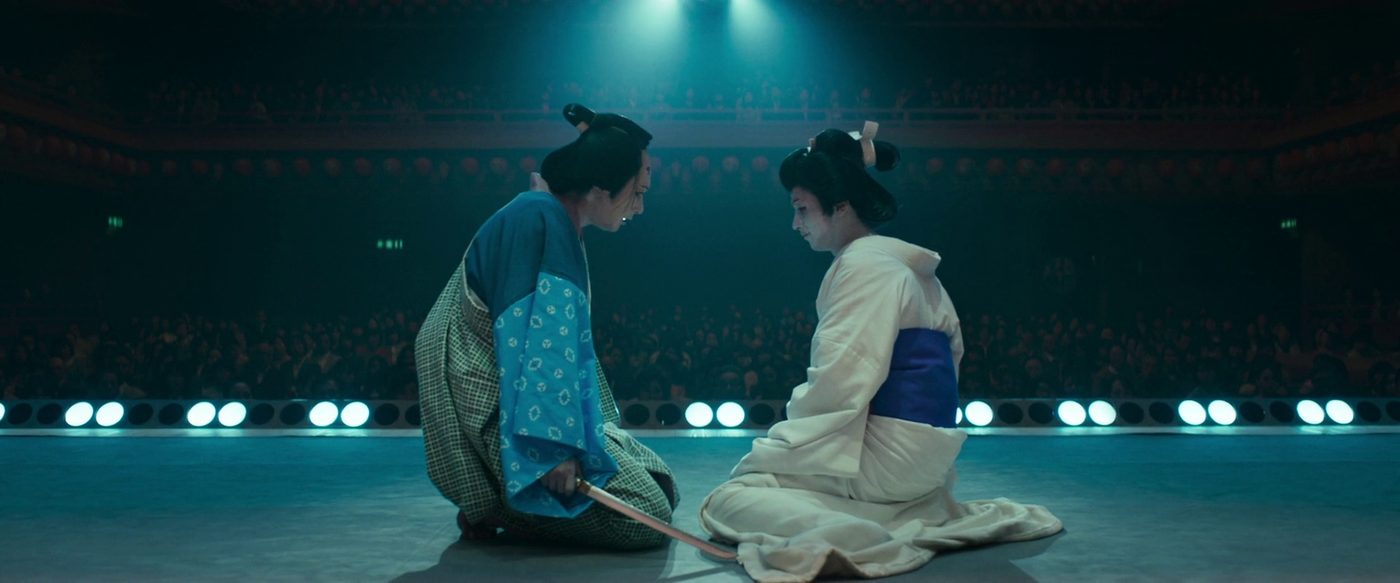
The brothers in Sonezaki Shinjū, Kikuo as Tokubei and Shunsuke as Ohatsu. Kokuho (Lee Sang-il, 2025).
Eve Kosofsky Sedgwick, building on René Girard's account of triangular desire in Deceit, Desire and the Novel (1961), argued in Between Men (1985) that when two men compete over a third term, the bond between the rivals is often stronger than the bond either has with what they compete for. Girard calls the mechanism mimetic, since each wants what the other has because the other has it, and the film sets up the brothers in just this way, with Kikuo hungering for Shunsuke's blood and Shunsuke for Kikuo's talent. The rivalry and the brotherly love are one relationship. The first thing they compete over is Ohatsu, a woman who exists only in a play and can never leave either of them.
The triangle has a living version offstage as well. Harue follows Kikuo from Nagasaki and leaves with Shunsuke on the night Kikuo is given the role, and her move from one brother to the other is where their rivalry first takes a human shape, which may be why the film can let her go from the frame once the role has taken her place. The same structure runs through the institution the brothers belong to. Kabuki lineage passes between men, from father to son and from master to disciple, from Hanjiro to Kikuo and from Mangiku to Kikuo, with women as the means by which it passes, since Sachiko, Hanjiro's wife, holds standing only through her son and Akiko only as Sengorō's daughter. Followed this far, Sedgwick's triangle is just the system of blood and patronage that decides the brothers' fortunes.
This is where the question I started with, what desiring the feminine does to a man, gets its answer. The film answers it by showing how the performance of femininity becomes something men want to possess. The brothers want Ohatsu because playing her in Hanjiro's place makes one of them his heir, and each wants her more because the other does, so that the femininity they compete over works as the currency of a contest between men. The ideal I described at the start, femininity made desirable through the body of a man, is something a man in this world can win and hold as an achievement, and winning it does not make Kikuo any gentler offstage. His harshness toward the women in his life deepens as his art does, and the women themselves are wanted mostly as means, Harue as a tie to Nagasaki and Akiko as a way into Sengorō's house, while the woman everyone in the film is allowed to desire is the one who exists only on stage.
Two monsters
Mangiku complicates the film's answer, and his presence in the story is what gives that answer its nuance. He is the film's one figure whose whole life seems given over to the role, and the film presents him as changed by it, to the point where Kikuo and Shunsuke, watching him dance Sagi Musume, catch their breath at him as a "beautiful monster," utsukushii bakemono. A bakemono is a thing that has changed its form, a creature that has passed out of one kind of being into another, and what the boys see in Mangiku is a beauty that no longer seems to belong to a person. They catch their breath because the dance has gone past what they thought a human body could do on a stage. In Onodera's reading, that change is reached by sacrificing everything except the art. Mangiku's own beauty, which by then seems to belong to no one, bears out the warning he gave Kikuo as a boy. He suggests what the feminine, pursued as pure art, might do to a man who gives himself to it entirely, and what the film shows is a kind of self-erasure, a man who ends with the art passing out of him into someone else.
Kikuo reaches a monstrosity of his own by the end, though I think it differs from Mangiku's. Mangiku's beauty is seen by others, and the boys who watch him recognize it as something beyond them, whereas Kikuo's is solitary. By the end, Onodera sees him as an inhuman "national treasure" who has come to find his father's death honestly beautiful. Few in the audience or among his fellow actors could follow such a sensibility, and Onodera takes this as the reason the film shows him alone, in a place where no one else is.
Perhaps the dissonance begins on the night his father died. Kikuo saw then, at an age when he could not have named it, that a traumatic experience could also be beautiful, and the idea he pursues afterward carries that dissonance beneath it without his knowing. Mangiku erases himself so that the art can pass through him to an audience. Kikuo's pursuit runs the other way, back toward the courtyard, and it reads as a self-destruction forged through beauty, one that takes the people around him with it.
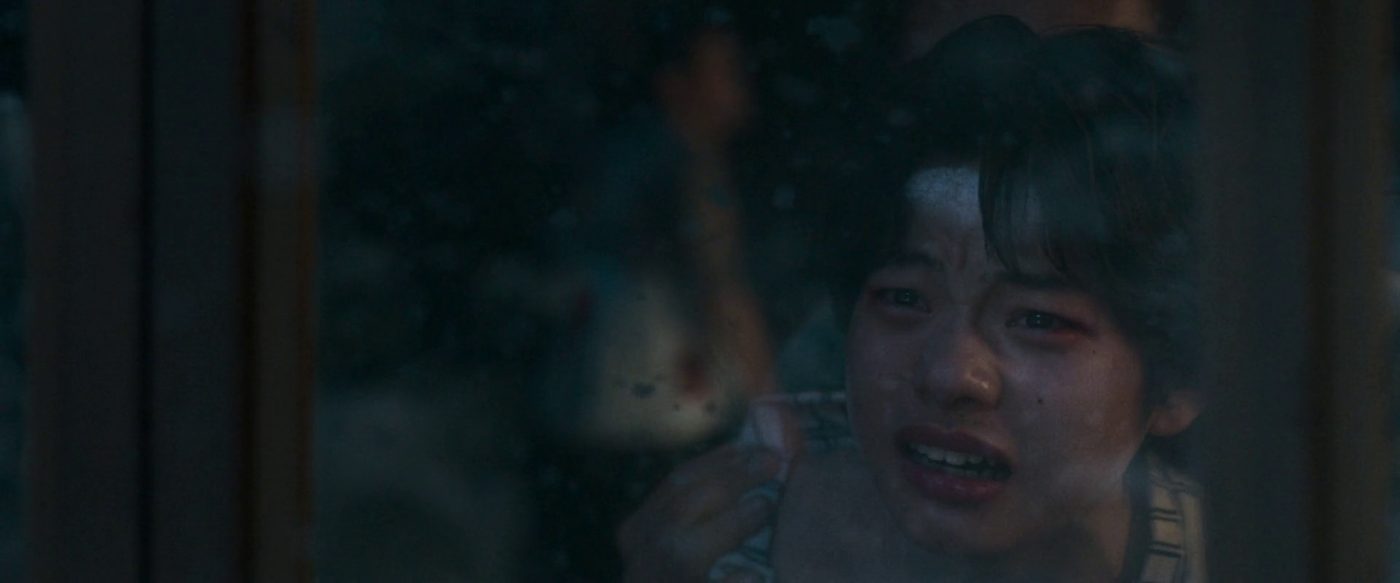
The boy Kikuo watching the raid through the glass. Kokuho (Lee Sang-il, 2025).
Two kinds of luck
Before the brothers' first appearance together, in Futari Dōjōji, Hanjiro assures Shunsuke that his blood will protect him, and Kikuo that his art will. The line returns when Kikuo is given the role of Ohatsu; overwhelmed, he admits that he cannot stop shaking and says that he has no blood to protect him. The film's own framing has each young man hungering for what the other has, Kikuo for blood and Shunsuke for talent.
Blood is also literal here. Hanjiro and Shunsuke share diabetes, and Shunsuke loses his left leg to it while, by the end, the right is failing as well. The lineage gives Shunsuke his name and his future, and the same blood gives him the disease that ends him. Sachiko doubts the wisdom of taking Kikuo in from the start and keeps her son first throughout, guarding the lineage harder than anyone in the household, perhaps because, barred from the stage as a woman, she has no standing in that world except through her son.
My first notes on the film said it was about the unfairness of fate, bloodline and hard work. Both brothers work brutally hard, though, so the film's real contest lies between two kinds of luck, the family one is born into and the talent one is born with. Kikuo's talent is noticed when he is a boy at a gangster's party, before any training, and Kant's definition of genius already concedes the point: "Genie ist das Talent (Naturgabe), welches der Kunst die Regel gibt," genius is the talent, a gift of nature, that gives the rule to art.[11] A gift of nature is as unchosen as a family name, and hard work, on this view, is what both inheritances demand, and what allows each of them to look earned.
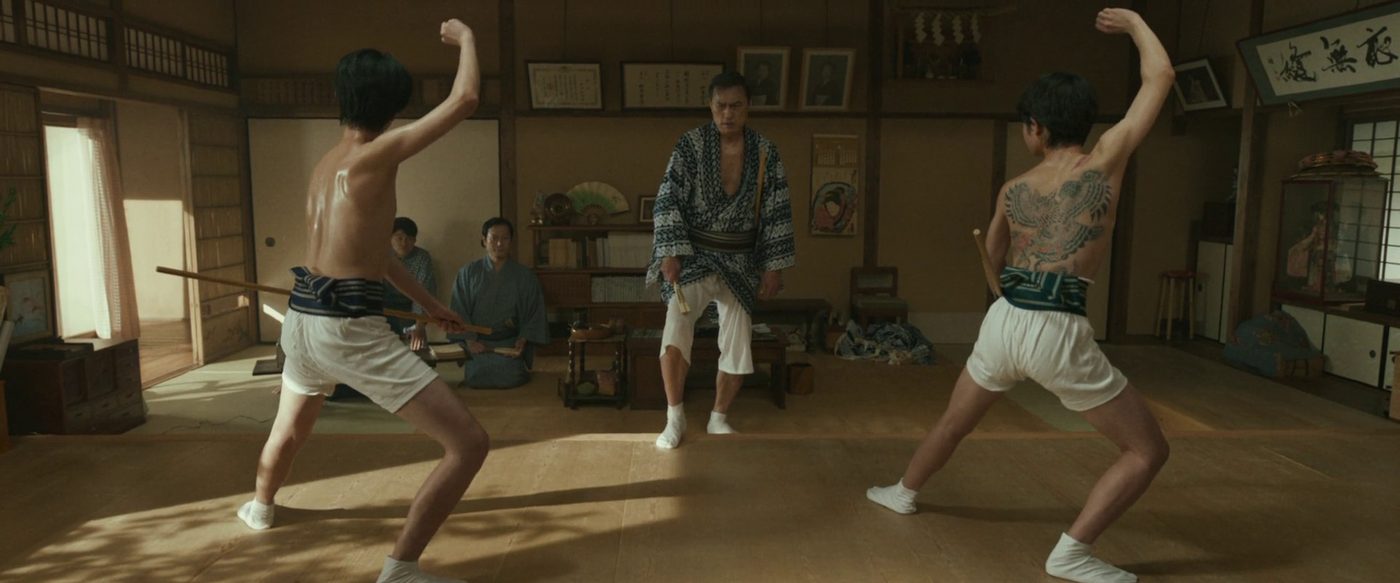
Kikuo and Shunsuke in training under Hanjiro. Kokuho (Lee Sang-il, 2025).
The real kabuki world gives this a concrete form. When Hanjiro chooses Kikuo to replace him as Ohatsu, Sachiko objects that Kikuo is only a heyago and that the role belongs by right to her son. A heyago is a real position in kabuki, a promising disciple or child actor whom a senior actor takes in and places above a disciple and below a son.[12] Children placed this way are kept in the actor's dressing room from childhood and trained in the art and in its backstage manners, as candidates for leading roles. Bandō Tamasaburō V, now a Living National Treasure, came up this way before Morita Kan'ya XIV adopted him,[12:1] so Kikuo's path from heyago to the national title follows a real precedent. For a performer from an ordinary family the other main route is the National Theatre's training program followed by an apprenticeship with a senior actor.[13]
Even inside, the house tends to count for more than the art. A commentator quoted in Gendai Business points out that kabuki has no absolute standard for judging whether an actor's art is good or bad, so the measure used to rank actors is how many years their house has lasted. Kabuki calls actors outside the lineages monbatsu-gai, and their annual joint performance sold out almost completely in the summer of 2025, after the film's release.[14] One young onnagata from an ordinary family, Kataoka Ichiya, who entered kabuki after university, told an interviewer that he envied Kikuo, and he read Kikuo's last words, "How beautiful," as something only a person who had kept at the art to that age could see.[15] Given everything Kikuo loses, what a real outsider envies is presumably the recovery. Kikuo falls from grace because the institution prefers a son of the house, and once Shunsuke returns, the standing Kikuo had won as an onnagata goes back to the bloodline. The film still lets him come back from that fall and stay on the path long enough to receive the national title, a return that an actor outside the lineages can rarely count on. To cheer Kikuo's rise as talent winning out over blood is still to cheer for luck, since his talent was given to him as much as Shunsuke's name was given to Shunsuke.
The snow, again
Kokuho belongs to a family of films about chasing perfection through art, Birdman, Whiplash, Black Swan, and they share a recognizable frame. A cruel mentor presents his cruelty as teaching, whether Fletcher in Whiplash, Thomas in Black Swan, or Hanjiro here; relationships are given up, as when Andrew ends things with Nicole before she can distract him; the body pays, in Andrew's bleeding hands and Nina's self-inflicted wounds; and a final performance is where the artist finally gets what they paid for, Andrew's drum solo, Riggan's real bullet, Nina bleeding and saying that she was perfect.
Kokuho keeps the frame and alters its terms. In the Western films the cost falls chiefly on the artist's own body, and the film ends at the peak, so the audience never sees what comes after. Kokuho places most of the cost on other people, on Harue and Fujikoma, on Akiko and Ayano, and finally on Shunsuke, whose body breaks apart, and it lets Kikuo survive, following him for decades past his peak into old age and state honor. The Western films also run on the Romantic idea of genius as an original self breaking through convention, with the conservatory or the ballet company serving as backdrop for the breakthrough. Kikuo's medium is a Way, a tradition of inherited form in which mastery means passing wholly through what was handed down, and his drive to be the greatest, sealed in the bargain with a devil that the film stages for him, is a Romantic will lodged inside an institution built for self-effacement. The family in Whiplash is the private world that cannot understand art, whereas in Kokuho the family is the institution, and Hanjiro is father and teacher at once.
The closest rhyme is with Black Swan, since both films end on a white bird-maiden. Nina must let a dark double break through for her performance to be perfect, and the film codes that double as a repressed self erupting onto the stage. Kikuo's heron maiden, a spirit tormented by love who dies in the snow, becomes instead the form in which an image he has carried since childhood finally finds expression.
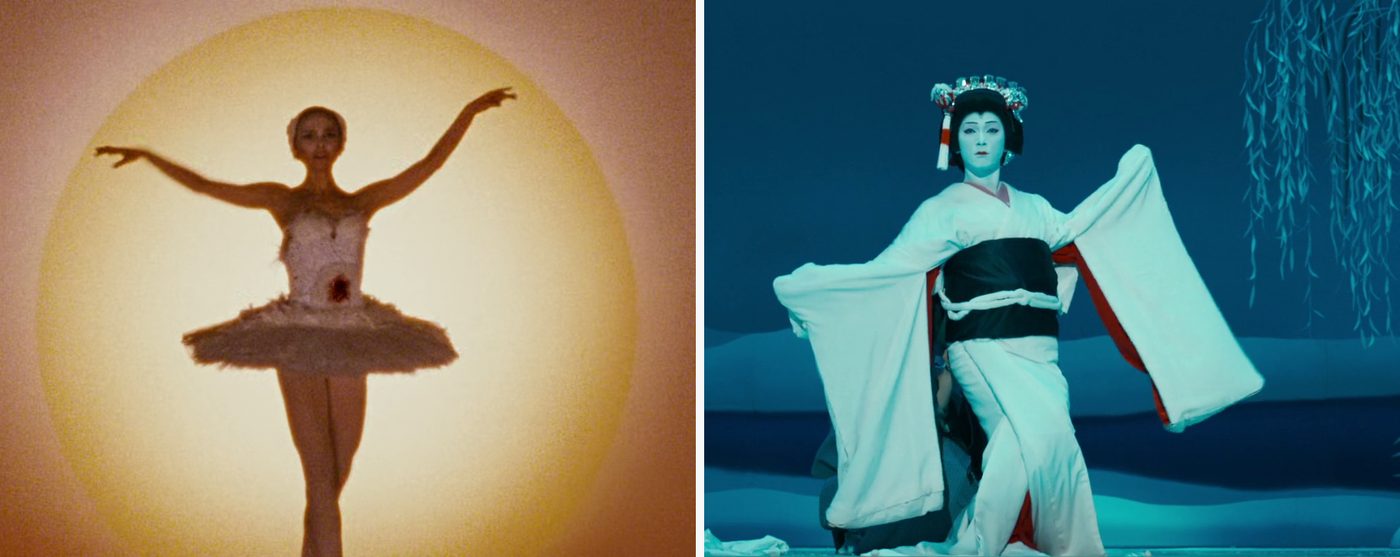
Left: Black Swan (Darren Aronofsky, 2010). Right: Sagi Musume in Kokuho (Lee Sang-il, 2025).
Near the end, Kikuo, now a Living National Treasure, tells an interviewer that he has been chasing a certain scenery all his life and cannot describe it, and shortly afterward he stands looking out over the Japanese garden of a hotel. Ayano, grown and working as a photographer, comes to him in these last scenes. Then he dances Sagi Musume, a dance traditionally performed beneath falling snow, and the film suggests that he finally sees what he has been looking for. If Onodera is right, that scenery is the courtyard in Nagasaki, and the heron maiden in the snow carries its colors.
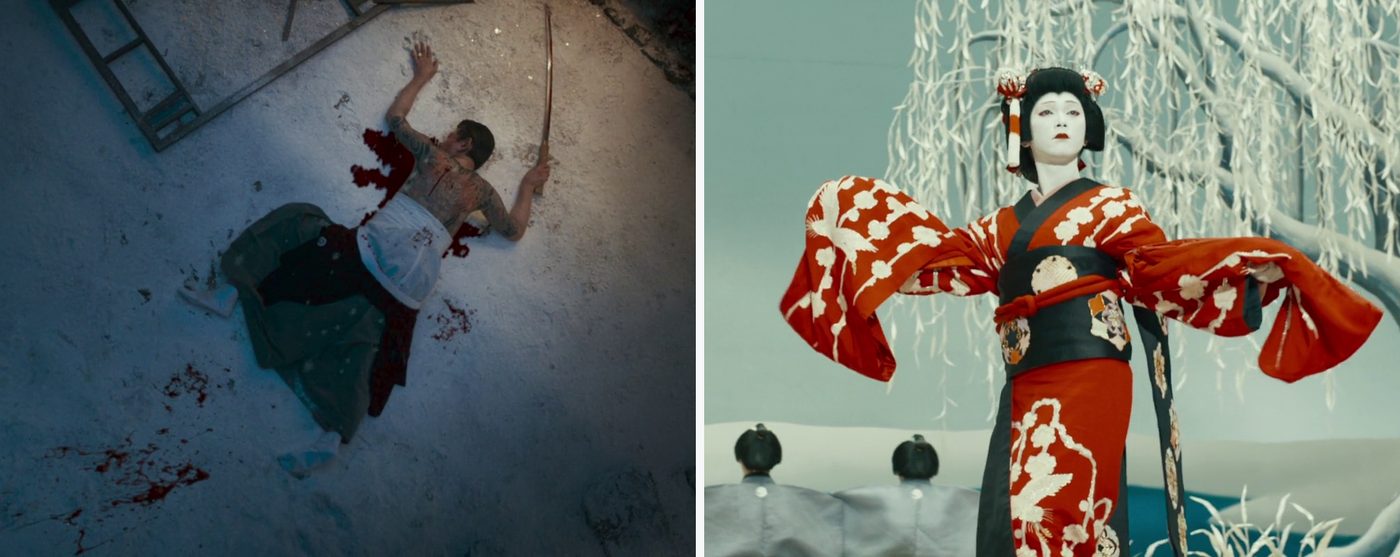
The courtyard in Nagasaki and the heron maiden's red. Kokuho (Lee Sang-il, 2025).
In the last scene he looks up from the stage and says, "How beautiful" (kirei ya nā), and the film never shows us what he sees. Mangiku's warning has come true for him as well. Kikuo already possessed the beauty of an onnagata's face, a talent inherent in him, and a talent left to feed on itself as its own entity, trained for a lifetime but never given limits, is like a fire in a gifted man that grows so hot and bright it consumes everything around it and turns all attention onto itself. Mangiku's art is the cultivated fire. It cost him too; Onodera is right that he gave up everything except the art. But what he burned was himself, and the fire faced outward, toward the people watching, so that the boys in the audience could see it and be changed by it. Kikuo's fire burns the people around him, and though full houses watch it, it faces back toward a courtyard only he remembers. The state does not discern the difference between the two fires. It gave Mangiku the title of Living National Treasure, and it gives Kikuo the same title once his beauty has become something only he can see. The honor certifies his monstrosity under the same name it once gave Mangiku, treating a passage reached through the snow in Nagasaki as if it were the same as a life given wholly to the role.

The final Sagi Musume. Kokuho (Lee Sang-il, 2025).
The film became the highest-grossing Japanese live-action film of all time and the first in twenty-two years to pass ten billion yen,[16] and the near sellout of the monbatsu-gai actors' joint performance in the summer of 2025 suggests it revived interest in kabuki itself. When the audience of the institution being criticized embraces the film this warmly, I think the honest conclusion is that the film contains less critique than it seems to. It shows the cost clearly, but it shows it beautifully, and the beauty is what people bought tickets for. Kabuki didn't need to defend itself against Kokuho; the film sent people back to its theaters.
Some will read the ending as a reconciliation, the persona and the image under it finally joined in one performance. I don't. What Kikuo sees from the stage is the courtyard, and to see it he had to spend everyone who might have stood beside him there. The film puts the state's honor in the same closing stretch as that vision, and the title of Living National Treasure, given in the name of an institution whose lineages kept Kikuo outside, reaches him exactly when his art has become something only he can see. The applause that follows, in the film's theater and in ours, goes to a beauty that Harue, Fujikoma, Akiko, Ayano, and Shunsuke paid for without ever being asked.
Further reading
- Lee Sang-il, dir., Kokuho (2025), from Yoshida Shūichi's novel Kokuho (Asahi Shimbun Publications).
- Onodera Kei, "『国宝』が描いた'美'への倒錯的な狂気," Real Sound, 17 June 2025.
- Zeami, Fūshikaden, ch. 7.
- Ihara Saikaku, Nanshoku ōkagami (The Great Mirror of Male Love, 1687), trans. Paul Gordon Schalow (1990).
- Gary P. Leupp, Male Colors: The Construction of Homosexuality in Tokugawa Japan (1995).
- Gilles Deleuze and Félix Guattari, Anti-Oedipus, ch. 1, §4.
- C. G. Jung, Two Essays on Analytical Psychology, CW 7, §246.
- Mizoguchi Kenji, dir., The Story of the Last Chrysanthemums (1939).
- Kikuchi Kan, "Tōjūrō no koi" (1919).
- Mishima Yukio, "Onnagata" (1957).
- Vimalakīrti Sūtra, trans. Kumārajīva, ch. 8 (佛道品).
- René Girard, Deceit, Desire and the Novel (1961; trans. Yvonne Freccero, 1965).
- Eve Kosofsky Sedgwick, Between Men: English Literature and Male Homosocial Desire (1985).
- Immanuel Kant, Critique of Judgment, §46.
- Darren Aronofsky, dir., Black Swan (2010).
Zeami, Fūshikaden, ch. 7. ↩︎
Angelika Koch, "Brave and Beautiful Boys", Japan Past & Present. ↩︎
Japan Past & Present, reading list on male-male love; Ihara Saikaku, The Great Mirror of Male Love, trans. Paul Gordon Schalow (Stanford University Press, 1990). ↩︎
Gilles Deleuze and Félix Guattari, Anti-Oedipus, ch. 1, §4. ↩︎
C. G. Jung, Two Essays on Analytical Psychology, CW 7, §246. ↩︎
Onodera Kei, Real Sound, p. 2. ↩︎
Lee Sang-il, interview, Hollywood Reporter Japan. ↩︎
Vimalakīrti Sūtra, Kumārajīva's translation, ch. 8 (佛道品): 卑濕淤泥乃生此華. ↩︎
Immanuel Kant, Critique of Judgment, §46. ↩︎
see where this came fromtip on Ko-fi
From here
- Sacrifice, substitution, and the remainder of grief / Folk horror from The Lottery to Midsommar and Pluribus.
- Great Art as a Referential Object Towards Human Nature / Dissecting the human while keeping it alive.
- I. On the insatiability of desire.
- Monsters and Overcoming Our Selves / The dormant shadow and unintegrated suffering.
- On Experiencing Art / Time, authenticity, and the blood pact of creation.
Kael Espino. “Kokuho, Two Inscriptions.” enjambments, Nov 23, 2026. https://enjambments.com/thoughts/kokuho-two-inscriptions/
@online{espino2026kokuho,
  author = {Kael Espino},
  title = {Kokuho, Two Inscriptions},
  year = {2026},
  date = {2026-11-23},
  url = {https://enjambments.com/thoughts/kokuho-two-inscriptions/}
}
All 9 connections
- Sacrifice, substitution, and the remainder of griefFolk horror from The Lottery to Midsommar and Pluribus
- Great Art as a Referential Object Towards Human NatureDissecting the human while keeping it alive
- I. On the insatiability of desire
- Monsters and Overcoming Our SelvesThe dormant shadow and unintegrated suffering
- On Experiencing ArtTime, authenticity, and the blood pact of creation
Select any words to keep them
One letter a month
Reader
- Essays a few days early (every essay stays public)
- Your name in the acknowledgements, if you want it
Interlocutor
- Everything in Reader
- First claim on prompt requests, one each quarter
- A word from me when the piece is done
You have read the whole path